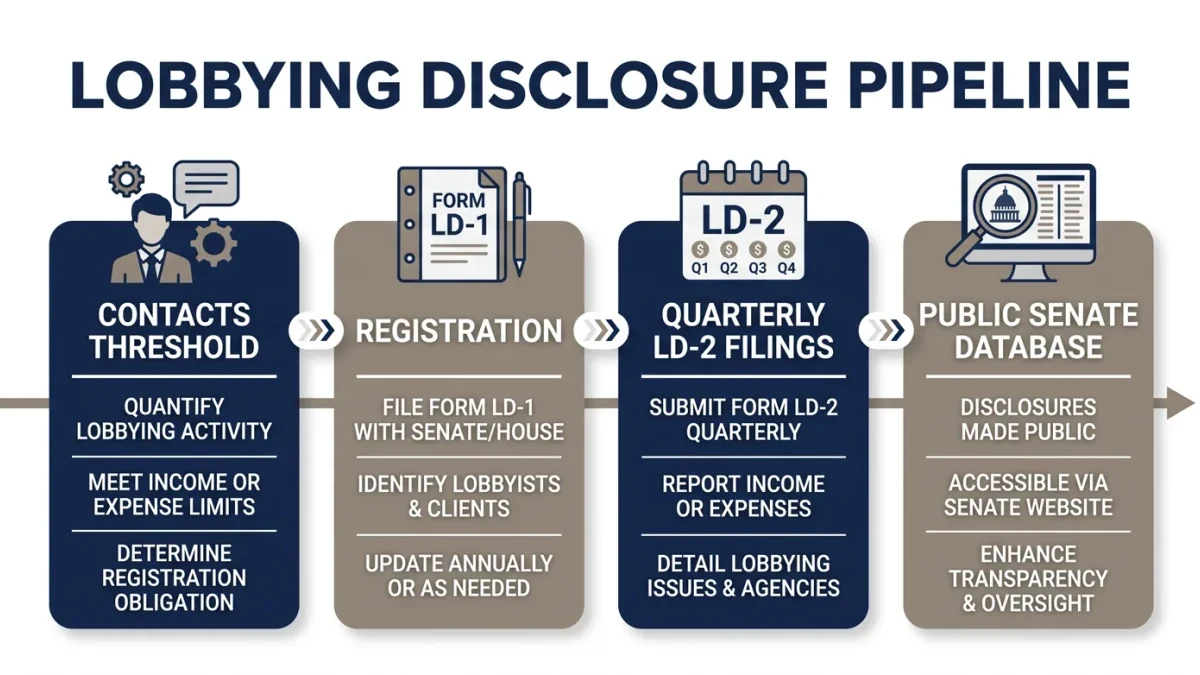
Lobbying disclosure in the United States runs on two statutes. The Lobbying Disclosure Act of 1995, sharpened by the Honest Leadership and Open Government Act of 2007, requires registered lobbyists to file quarterly reports naming clients, issues, and amounts received, and covered employers to file semi-annual reports on their own lobbying. The Foreign Agents Registration Act of 1938, enforced by the Justice Department, separately requires agents of foreign principals to file detailed public registrations. In 2024, filed lobbying revenue disclosures under the LDA totaled roughly 4.4 billion dollars across more than 12,000 registered lobbyists, per OpenSecrets' compilation of Senate records. Reliable News publishes information, not legal advice; this explainer describes the framework.
Who has to register as a lobbyist?
Anyone who is paid, makes more than one lobbying contact, and spends at least 20 percent of their time for a client on lobbying activities over a quarter — the two-contact, 20-percent test. Registration is with the Clerk of the House and Secretary of the Senate, jointly, and it must happen within 45 days of first meeting the threshold. The definition of lobbying contact is broad — any communication with covered officials on legislation, rules, programs, or policy — but it has carved-out exceptions, most consequentially the lobbying derogation for communications that are made in response to an official's request for information or that are part of a proceeding.
What gets reported, and how accurate is it?
Quarterly LD-2 reports list each client, the houses of Congress and agencies lobbied, the specific issues — down to bill numbers — and income in brackets of up to 10,000 dollars, or precise amounts for in-house lobbying over the reporting threshold. HLOGA tightened the brackets, added campaign-contribution disclosure, and criminalized knowing failures to comply. The record on accuracy is mixed by design: bracketed amounts understate precision, and studies comparing reported and estimated lobbying totals find systematic underreporting concentrated in grassroots and coalition work, which the statute defines narrowly enough that much persuasive activity sits outside it.
What does the 20-percent test leave out?
Most influence work. Strategic advice, coalition management, grassroots mobilization, and preparation of materials fall outside lobbying activities if they involve no covered contacts, and professionals who stay under 20 percent are not lobbyists at all — the so-called Harry Reid loophole discussion after the 2015 LDA revision narrowed preparation time. Political intelligence — selling to investors information gathered from officials — is entirely unregulated despite a 2012 floor vote against requiring its disclosure. The analysis: the statute covers the transactional core of lobbying well and everything adjacent poorly, which is why reform bills recur in each Congress without moving; both parties' allies benefit from the boundary as drawn. What would change the reading is a major enforcement action reinterpreting the definitions, which the U.S. Attorney's office for the District of Columbia — the designated enforcer — has not brought at scale.
How does FARA differ?
Its trigger is the client, not the activity: anyone acting as an agent of a foreign principal — a government, political party, or entity under foreign control — for political or quasi-political purposes must register with DOJ, file informational materials, and label propaganda as foreign-sponsored, with no de minimis threshold and no 20-percent test. FARA enforcement, dormant for decades, produced a run of prosecutions after 2017 — Paul Manafort, Maria Butina, and the parent cases of QAnon-adjacent figures — and DOJ's own 2022 advisory opinion process acknowledging over-inclusiveness led to its proposed narrow exemption for LDA-registered lobbyists representing commercial clients. The two regimes overlap: an LDA-registered lobbyist for a foreign state-owned enterprise may need a FARA registration too, and getting that call wrong is the most common indictment count.
What about the revolving door?
HLOGA extended cooling-off periods: one year for House members and senior staff from lobbying their former colleagues, two years for senators and Senate staff under the Senate's own rule. Presidents add their own, typically a two-year ban by executive order, with waiver authority. Research compiled by the Congressional Research Service finds the majority of departing members of Congress in recent cycles have registered or advised in the influence economy, which the disclosure system at least makes countable.
Where can the filings be read?
The Senate's lobbying database publishes every LD-2 and LDA registration; DOJ's FARA office publishes registrations and supplemental materials within days of filing; and OpenSecrets and LegiStorm maintain usable front ends. The files are the point: every number above traces to them.
Frequently asked questions
Do lobbyists have to disclose how much they are paid?
Yes, in brackets — up to 10,000-dollar bands for retained lobbyists, and good-faith estimates of in-house lobbying expenses above the 13,180-dollar threshold, adjusted periodically. Precise figures are rarely required, which is the statute's main transparency gap.
Is lobbying the same as bribery?
No. Lobbying is paid advocacy, legal when disclosed; bribery is a trade of official action for value, criminal in every form. The line runs at quid pro quo, and prosecution requires proving the exchange, not mere access or campaign support.
Who enforces the LDA?
The U.S. Attorney for the District of Columbia, by statute. Enforcement has been rare — a handful of settlements since 2007 — with compliance instead driven by reporting audits, corrections filings, and reputational exposure of the public database.
What does FARA require that the LDA does not?
FARA has no minimum time or contact thresholds: any agency work for a foreign principal with political purposes triggers registration, public labeling of materials, and detailed disclosures of the relationship. It reaches public-relations and media work the LDA never touches.