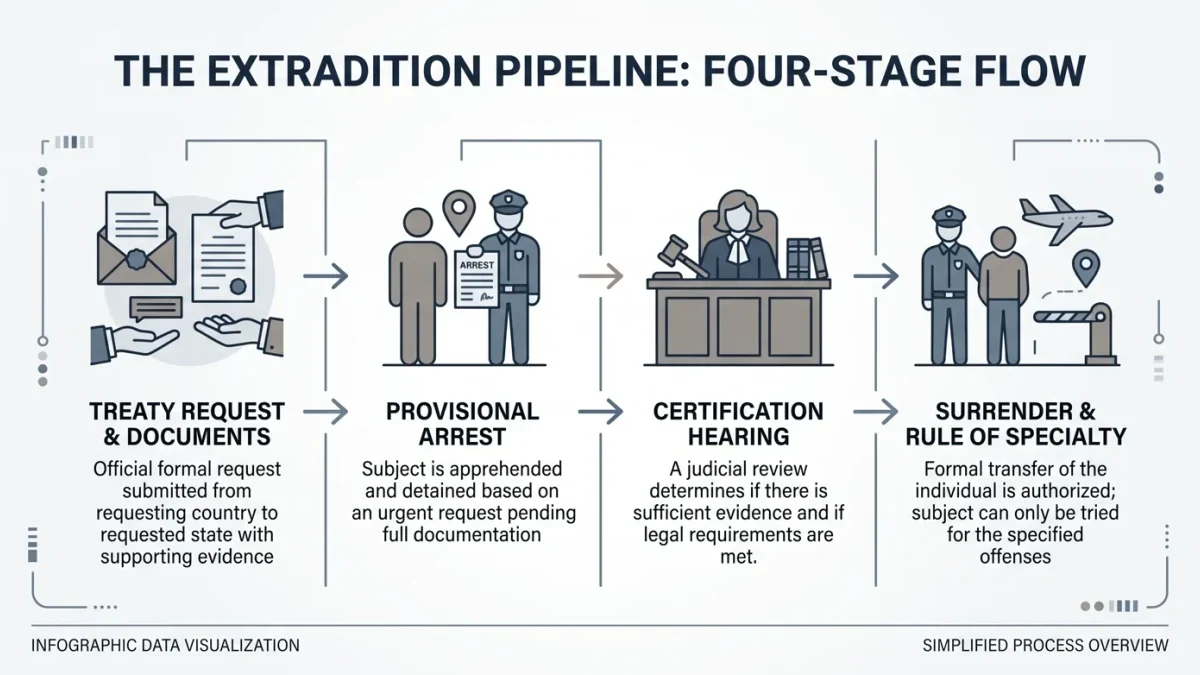
Extradition is the formal process by which one state surrenders a person to another state for prosecution or punishment. It exists only by agreement: the United States is party to more than 110 bilateral extradition treaties, administered by the Justice Department's Office of International Affairs, and every request must satisfy the treaty's requirements — most fundamentally dual criminality, that the conduct be a crime in both states. The machinery moves thousands of cases quietly: U.S. federal data show several hundred people extradited to and from the United States in a typical year, against a backdrop of high-profile contests from Julian Assange to drug-trafficking defendants in Mexico and Colombia. This explainer covers the machinery as treaties and statutes define it.
What must a requesting state show?
A treaty in force, a charge that meets dual criminality, and documentation — the arrest warrant, the evidence summary sufficient under the treaty standard, and identity proof. Many treaties add a seriousness threshold, felony-level punishment of at least one year's imprisonment. The requested state's courts then hold a certification hearing, which in the United States is not a trial: the judge asks whether the person is the person charged and whether the treaty's probable-cause or evidentiary standard is met, under the standard the Supreme Court set in Collins v. Loisel in 1922 and refined since. Guilt is for the requesting state's courts.
What are the standard refusal grounds?
Political offenses — the exception written into nearly every treaty since the Belgian attempted-assassination case of 1856 gave it its modern form; nationality, in civil-law states that will not surrender their own citizens; military and fiscal offenses in older treaties; the death penalty, where the requesting state must give assurances of non-execution under Soering-line European jurisprudence and specific U.S. treaty practice; and specialty — the rule that the person may be tried only for the offenses for which extradition was granted, enforced strictly enough that prosecutions have been dismissed for breach. Human-rights bars, including prison conditions and persecution risk, have grown into the doctrine through the European Court of Human Rights' case law and national courts' proportionality review.
How do famous cases fit the pattern?
Julian Assange: seven years of Ecuadorian asylum in London ended in 2019, and years of litigation over the U.S.-U.K. treaty's political-exception and First Amendment arguments ended with a plea deal in 2024 — the machinery bent slowly rather than breaking. Roman Polanski's decades as a French-Polish resident rest on nationality and refused-transfer politics, the exception side of the ledger. Drug-trafficking extraditions from Colombia and Mexico after the 1990s and 2000s treaty revisions show the volume side — thousands surrendered, with Colombia's and Mexico's constitutional reforms in 1991 and 1996 replacing blanket nationality bars with surrender rules. Huawei executive Meng Wanzhou's 2018-2021 Vancouver detention on a U.S. request showed the geopolitics that runs through the docket: it ended in a deferred-prosecution agreement, not a court ruling.
What about Interpol and red notices?
Interpol does not extradite anyone. Its red notices are requests to locate and provisionally arrest, and the organization's constitution bars intervention of a predominantly political, military, religious, or racial character — the basis on which its review bodies have deleted notices in contested cases, and the basis of the U.S. statute allowing challenges to red-notice-based detentions. Actual surrender always runs through the treaty channel.
Where is the system contested?
Three fronts. Political weaponization — the U.S. criticism of Russian and Chinese notices against exiles, answered by those states' parallel criticism of U.S. cases — with review by Interpol's Commission for the Control of Files as the imperfect referee. Forum and proportionality litigation in European courts, where surrender under the European Arrest Warrant has been refused over prison conditions and trial rights. And the U.S. capital-punishment channel, where assurances-based extradition remains a standing bilateral irritant. The analysis: extradition's designers made surrender a legal question to keep it out of pure diplomacy, and the doctrine's exceptions are where the politics re-enters — every famous case turns on an exception, while the thousands of routine surrenders turn on none. What would change the reading is systematic abuse of the specialty rule or the political exception collapsing under terrorism-era pressure, which treaties' post-2001 reforms have tested but not eliminated.
Frequently asked questions
Can a country refuse to extradite its own citizens?
Many civil-law states — Germany, France, China, Russia — bar or strictly limit surrender of nationals, prosecuting them at home instead. Common-law states including the United States, the U.K., and Canada extradite citizens routinely under their treaties.
Is a hearing required before extradition?
Yes in the requested state: a certification hearing verifying identity and the treaty's evidentiary standard, with habeas review available. It is not a trial of guilt; the merits are tried in the requesting state under the specialty rule.
What is the political-offense exception?
A clause in nearly all extradition treaties barring surrender for political crimes, modernized after 1970s terrorism to exclude attacks on civilians. Its scope is the most litigated exception — espionage and leak cases raise it directly.
Does Interpol arrest people?
No. Interpol issues red notices — lookouts — and member states choose whether to detain provisionally pending a treaty request. Surrender happens only through bilateral extradition procedures, and Interpol's review bodies can delete politically motivated notices.