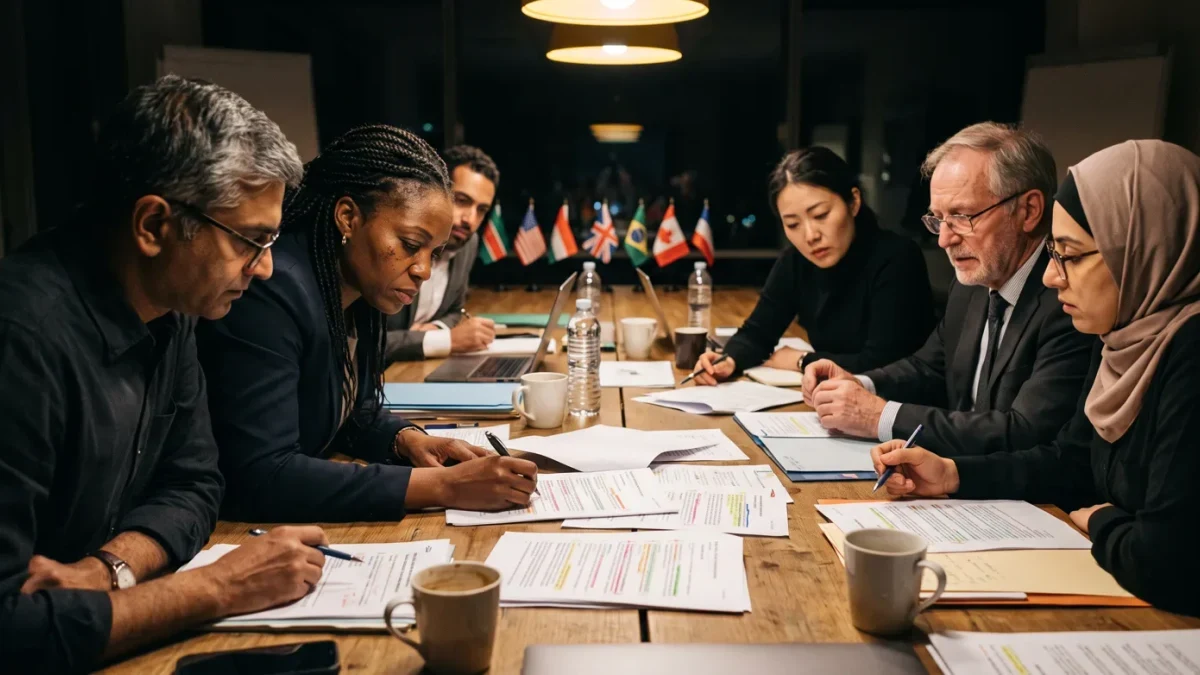
A G20 summit is the endpoint of roughly a year of layered negotiation. The Group of Twenty — 19 countries plus the African Union, admitted in 2023, and the European Union — has met at leaders' level annually since the 2008 financial crisis created the format. The 2024 Rio de Janeiro summit's outcome documents ran to tens of thousands of words across the leaders' declaration and dozens of ministerial statements; the 2025 South African presidency ran the first summit on African soil in Johannesburg. None of that text is written at the summit. It is pre-negotiated by sherpas and ministers, and the leaders' meeting largely ratifies what the track system has already settled — or exposes, by disagreement, what it could not.
What is the sherpa track?
The leaders' personal representatives — typically a senior diplomat or finance official in each delegation — who meet four to six times between summits to draft the leaders' declaration. The United States has rotated the job between the Treasury and the NSC depending on the administration's emphasis; the sherpa owns the political text: climate language, the war paragraphs, development commitments. Working groups fan out below them — energy transitions, health, anti-corruption, tourism, culture — each feeding paragraphs upward. The Rio 2024 declaration's 83 paragraphs were assembled across ten-plus sherpa meetings over eighteen months, and the drafting record shows how the war-in-Ukraine paragraph remained bracketed — unresolved — until the final pre-summit round, as it had at every summit since 2022.
What is the finance track?
The parallel channel run by finance ministers and central bank governors, meeting four times a year with deputies between, under the troika of past, present, and incoming presidencies. It produces the communiqus on debt, banks, taxes, and the international financial institutions, and its standing workgroups — the Framework Working Group on growth, the International Financial Architecture group on IMF quota and debt issues — carry multi-year agendas. The 2021 common framework for debt treatments and the 2023-2024 progress on reprofiling global sovereign debt emerged from this track, as did the crypto-assets roadmap adopted after the 2023 Indian presidency. The finance track's outputs bind no one — G20 statements are political commitments — but they set the agendas of the IMF, the Financial Stability Board, and the OECD, which do produce binding texts.
What actually happens at the summit?
Two days of choreography: a retreat session where leaders speak in turn from notes, restricted sessions without staff, bilaterals in the margins, and the family photo whose seating chart is itself negotiated. Texts arrive pre-agreed; what leaders can still change is emphasis and the handful of make-or-break paragraphs held back for the principals. The walk-outs show the machine's limits — the 2022 Bali summit's Ukraine language went to the wire; Argentina's 2024 refusal to sign the Rio declaration's inequality paragraphs showed a new government disavowing a text its predecessor had pre-negotiated, a growing pattern as election cycles turn over between the sherpa rounds and the summit.
Why does the rotation matter?
The presidency sets the agenda, and the troika continuity rule — current, past, next president consult on every major item — is the format's stabilizer. The 2023 Indian presidency ran roughly 200 meetings under one theme; Brazil 2024 centered hunger and inequality; South Africa 2025 solidarity and sustainability, with the U.S. delegation's partial boycott of Johannesburg's sessions the year's institutional drama; the U.S. presidency in 2026 will run the machine again. Rotation also disciplines ambition: nothing passes that the incoming presidency would unpick, which pushes the format toward consensus language the IMF and FSB operationalize later.
Is the G20 worth the cost?
The honest ledger has two columns. Delivered: the 2008-2009 coordinated stimulus and financial-regulation core, the debt-service-suspension initiative of 2020, the common framework, the crypto roadmap, and the standing value of keeping U.S.-China and G7-BRICS finance channels open when other formats freeze. Not delivered: the war-in-Ukraine paragraphs dissent annually, fossil-fuel phase-down language has softened each cycle since 2021, and inequality commitments arrive without financing. The analysis: the G20 is a coordination device, not a government — its power is agenda-setting through the institutions its communiques steer, and the year-long track system exists precisely because twenty leaders cannot negotiate in two days. What would change the reading is a presidency using the machine to push a binding instrument through the IMF or FSB, which the format's consensus rule has never permitted.
Frequently asked questions
What is a sherpa in diplomacy?
The leader's personal representative to a summit process — the official who attends the year-round negotiating rounds and pre-drafts the leaders' declaration. The title jokes that, like the Himalayan guides, sherpas carry the load so the leaders can summit.
Who attends a G20 summit?
Leaders of 19 member countries, the African Union since 2023, and the European Union, plus invited guest states — Spain permanently, and rotating regional chairs — and heads of the IMF, World Bank, FSB, OECD, and WHO. Finance ministers and sherpas attend in support.
Are G20 declarations legally binding?
No. Leaders' declarations and ministerial communiqus are political commitments. Their force comes from steering the IMF, World Bank, FSB, and OECD, whose implementing rules are binding on members or markets.
How is the G20 presidency chosen?
By rotation among regional groups, with a troika of past, current, and incoming presidencies managing continuity. South Africa held 2025, the first African summit; the United States takes 2026.