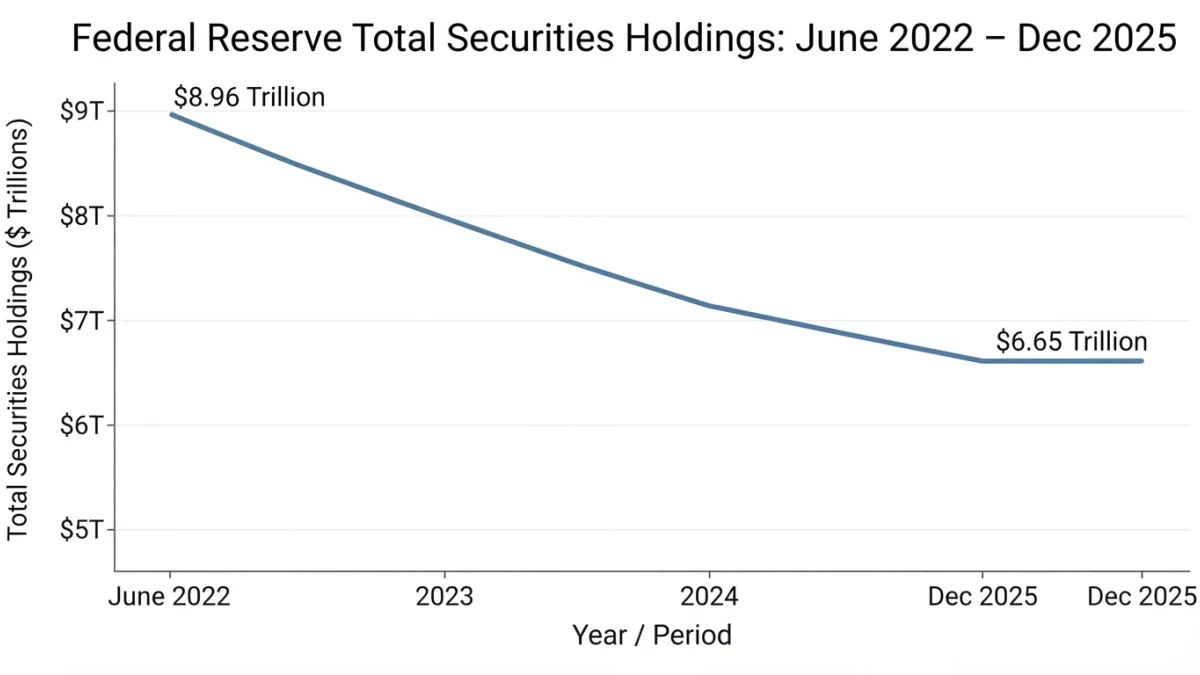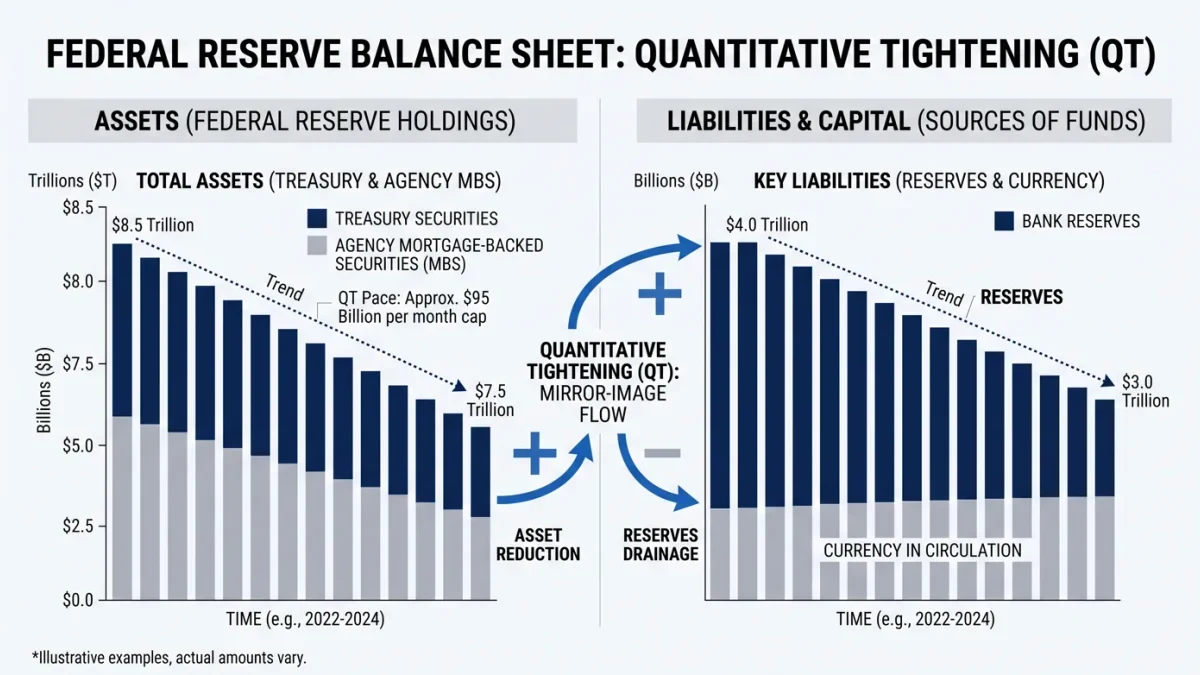
Quantitative tightening is the Federal Reserve's process of shrinking its holdings of Treasury and agency mortgage securities by letting them mature without reinvestment. The Fed built a roughly 9-trillion-dollar portfolio through three rounds of asset purchases — the 2008-2014 QE era and the 2020 pandemic response — and has been running it down since June 2022. By early 2026 the balance sheet stands near 6.6 trillion dollars, per weekly Federal Reserve data, after the pace of runoff was slowed in June 2024 to 25 billion dollars a month in Treasury redemptions with agency runoff reinvested. Every dollar of runoff drains bank reserves one-for-one: the Fed's liability side shrinks when securities roll off its asset side, and reserves are where the reduction lands. Reliable News publishes information, not investment advice; this explainer covers the machinery.
What actually happens mechanically?
The Fed's balance sheet has assets — the securities — and liabilities: currency, the Treasury's General Account, and reserves, which are commercial banks' deposits at the Fed. When a Treasury matures and the Fed does not reinvest, the Treasury pays the Fed from its account, and to replenish that account it sells new debt to banks, whose reserve balances fall as they pay. The portfolio shrinks; reserves shrink in mirror image; the private sector holds more Treasury duration. The Fed cannot control the split of its liabilities — reserves can fall faster or slower than the balance sheet as currency and the Treasury account move — which is why reserve levels, not balance-sheet size, are the operative variable.
Why do reserves matter?
They are the payment-system settlement asset and the raw material of money-market liquidity. After 2008's QE flooded reserves, the Fed moved to an ample-reserves operating regime: it steers the fed funds rate with administered rates — interest on reserve balances and the overnight reverse repo facility, or ON RRP — rather than by managing reserve scarcity. The standing question of QT is where ample ends: the September 2019 repo spike, when rates blew out to 10 percent with reserves around 1.4 trillion dollars, is the cautionary episode; the Fed's response then was to resume bill purchases and define a floor of reserves it would not breach again.
What happened in this cycle?
A 2.5-trillion-dollar contraction without a 2019-style blowout — with one scare. Reserves fell from a 2021 peak above 4 trillion dollars toward the low 3 trillions, while the ON RRP drained from 2.5 trillion dollars to near zero by 2025 — the facility acted as the shock absorber, with money funds moving cash from RRP into bills as QT's supply hit. The April 2024 episode — repo rates firming and a weak 30-year auction — prompted the June 2024 slowdown; the December 2024 halt of agency-mortgage runoff marked the next step; and through 2025 the Fed reiterated it would stop runoff when reserves are somewhat above the level consistent with ample, using money-market signs rather than a number as the gauge. The 2024-2025 evidence is the first soft landing from a large QT in the modern operating regime.
How does QT differ from raising rates?
Rates work through the price of money; QT works through quantity and duration. Rate hikes set the front end directly through administered rates. QT's transmission is debated: term premium — the extra yield for holding long — is the main channel, with the New York Fed's ACM estimates showing term premium rising from about negative 1.4 percent in 2021 toward positive territory in 2025, though attributing that to QT rather than fiscal issuance is contested. QT also removes bank reserves, which hikes do not, and adds Treasury supply to private portfolios, which affects dealer balance-sheet capacity, the 2019 lesson.
What are the standing risks?
Reserve scarcity arriving before the Fed's gauges catch it — the 2019 surprise, which is why the current doctrine leans on market-functioning signals: repo-rate spikes, reserve-demand convexity, ON RRP at zero meaning no buffer left. Treasury-bill supply crowding the same money-fund balance sheets that hold reserves, the 2023-2025 collision of issuance and QT. And political economy: QT runs alongside large fiscal deficits whose issuance the Fed is, in effect, no longer absorbing — the interaction some economists flag as the next cycle's stress point. The analysis: QT's design question was never whether the Fed can shrink its balance sheet — it has — but where the ample-reserves floor sits, and this cycle's slow-then-halt sequencing is the empirical answer being built in real time; the record argues the Fed will end QT with reserves higher than markets once guessed, the cost of 2019's memory. What would change the reading is a liquidity episode before the halt, which would reprice the whole doctrine.
Frequently asked questions
What is quantitative tightening?
The Fed letting maturing Treasury and agency securities roll off its balance sheet without reinvestment, which drains bank reserves dollar-for-dollar. This cycle began June 2022 and slowed in steps — to 25 billion a month in Treasuries in June 2024 — with the portfolio near 6.6 trillion dollars in early 2026.
What are bank reserves?
Cash balances commercial banks hold at the Federal Reserve, the settlement asset of the payments system and the buffer behind money-market liquidity. QE creates reserves; QT destroys them; the Fed now steers rates with interest on reserves rather than by managing their scarcity.
What was the 2019 repo crisis?
A September 2019 spike in overnight repo rates to 10 percent when reserves fell to about 1.4 trillion dollars, revealing the floor beneath ample. The Fed responded with bill purchases and adopted the doctrine of stopping runoff on money-market signs.
What is the ON RRP facility's role in QT?
The overnight reverse repo facility absorbed cash from money funds in the QE era; during QT it drained from 2.5 trillion dollars to near zero as funds shifted into bills, cushioning the fall in bank reserves. Its emptiness is why later QT phases carry more liquidity risk.