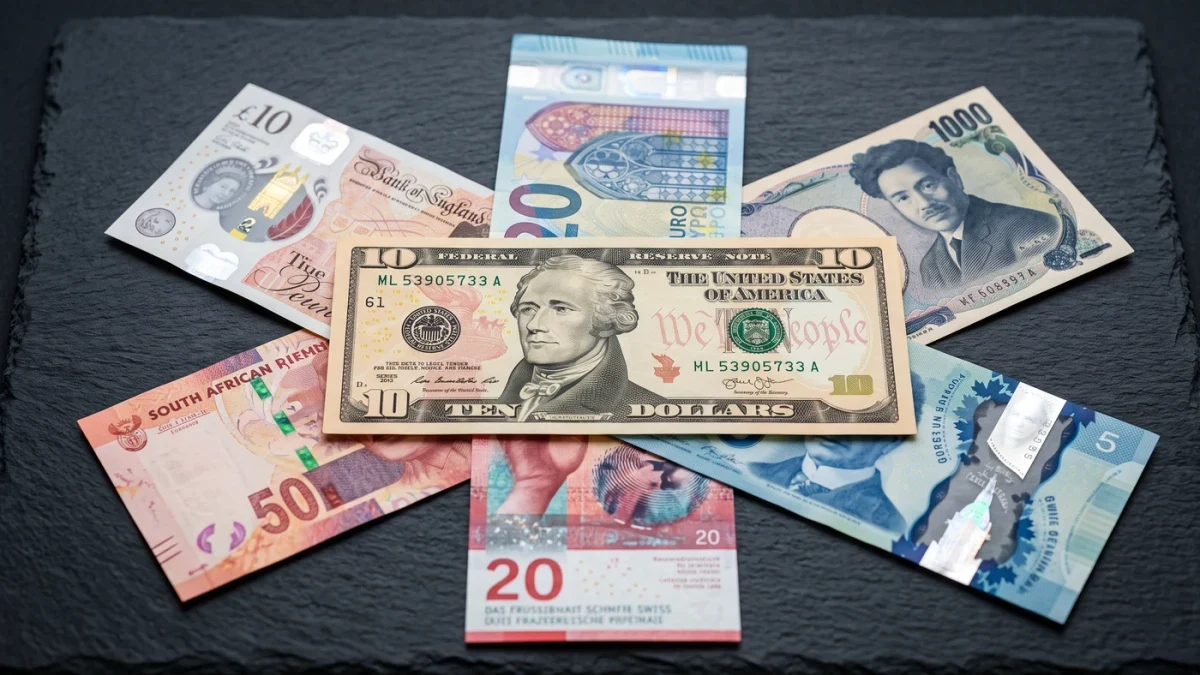
The U.S. Dollar Index, DXY, measures the dollar's value against a basket of six currencies: the euro at 57.6 percent, the yen 13.6, the pound 11.9, the Canadian dollar 9.1, the Swedish krona 4.2, and the Swiss franc 3.6. It was launched in 1973 after the Bretton Woods parity system ended, with weights frozen at 1973 trade patterns except for the euro's 1999 substitution for the Deutsche mark and other predecessors. A reading of 108 — where the index traded in late 2024 — means the dollar is 8 percent stronger than against the basket than at the 1973 base of 100. Despite the dated weights, DXY remains the most-quoted dollar benchmark in markets and commentary.
Why do those weights matter?
Because DXY is effectively a euro trade with five side bets: the euro's 57.6 percent share means the index can rise on euro weakness alone. U.S. trade with China, Mexico, India, or Brazil — the largest actual partners — is absent entirely, as are the Korean won and the Australian dollar. Broader gauges exist: the Fed publishes trade-weighted indexes — the broad dollar index covering 26 currencies weighted by U.S. trade shares, and the nominal and real major-currency indexes — which economists prefer for analysis even while headlines quote DXY. The two usually move together but diverge meaningfully at times, as in 2024 when the yen's fall dragged DXY up more than the trade-weighted measure.
How does the dollar's level reach trade flows?
Through pricing and balance sheets. Commodities are priced in dollars globally, so a stronger dollar raises non-dollar economies' cost of oil, metals, and food in local currency — one channel by which dollar strength exports inflation, which the World Bank and IMF have documented in commodity-importing emerging markets. Trade invoicing compounds it: roughly half of trade outside the United States is invoiced in dollars per the dominant-currency-pricing literature, so dollar appreciation raises import prices across third-country trade too. And dollar-denominated debt — over 13 trillion dollars owed by borrowers outside the United States per the BIS's quarterly reviews — becomes heavier to service as the dollar rises, the mechanism behind dollar-cycle stress in emerging markets.
What moves the index?
Interest-rate differentials first: the Fed's path against the ECB's and BOJ's sets the carry that drives flows. In 2022-2023, the Fed's faster hikes pushed DXY to a 20-year high above 114; the September 2024 pivot to cuts pulled it below 101 before the November 2024 election-month rally lifted it back toward 108. Safe-haven flows second: risk-off episodes, from the pandemic's March 2020 dash for dollars — when the Fed reopened swap lines and created the FIMA repo facility — to geopolitical spikes. Growth differentials third. The dollar's role as the global funding currency means these forces reinforce: global banks borrow dollars, so stress raises dollar demand even when the stress originates in the United States.
Does a strong dollar hurt the U.S.?
Tradeables, yes; consumers, no — the standard asymmetry. A stronger dollar makes U.S. exports dearer abroad and imports cheaper at home, squeezing manufacturing margins — the mechanism behind the strong-dollar complaints of U.S. exporters and the earnings warnings multinationals issue when the dollar rises, since foreign revenue translates into fewer dollars. Multinational S&P 500 profits are the index's own feedback loop: analysts' estimates embed dollar assumptions, and dollar rallies mechanically trim earnings-per-share. Consumers get cheaper imports and cheaper foreign travel. The 2025 tariff-dollar dynamic added a twist: tariffs and a strong dollar both suppress imports, and currency offset became part of the policy debate.
What are the index's honest limits?
The frozen basket, first: DXY reflects 1973 Europe, not 2026 trade. The base effect, second: long-run comparisons — the index's 1984-85 peak near 165 and its 2008 spike above 88 — are quoted as if continuous, though the euro substitution rebuilt part of the series. And index-ism, third: reading all dollar conditions off one number, when the dollar's global role runs through invoicing, debt denomination, reserves, and swap-line access, channels DXY measures only partially. The analysis: DXY survives because it is a liquid, tradeable contract — ICE lists futures and options on it — and a familiar headline gauge, but it is a lever on the euro more than a measure of the dollar's trade position; the Fed's trade-weighted broad index is the honest instrument for trade analysis, and the difference between the two is itself information about where dollar stress is concentrating. What would change the reading is a reweighting or displacement by a trade-accurate benchmark, which inertia has prevented since 1973.
Frequently asked questions
What is the DXY dollar index?
A weighted basket of the dollar against six currencies — euro 57.6, yen 13.6, pound 11.9, Canadian dollar 9.1, krona 4.2, franc 3.6 — launched in 1973. A reading of 108 means the dollar is 8 percent stronger than its 1973 base of 100.
Why is the euro's weight so high in DXY?
The weights date from 1973 trade patterns, when European currencies dominated U.S. trade among the basket's members. The index was never reweighted, so it functions largely as a dollar-euro gauge despite America's largest trade partners being absent.
What is the Fed's trade-weighted dollar index?
The broad dollar index: 26 currencies weighted by actual U.S. trade shares, in nominal and inflation-adjusted versions. Economists use it for trade analysis because it includes China, Mexico, and other major partners DXY omits.
How does a strong dollar affect emerging markets?
Through commodity prices, dollar-invoiced imports, and over 13 trillion dollars of dollar-denominated debt whose service cost rises with the dollar. Strong-dollar cycles have historically coincided with emerging-market stress, per BIS and IMF studies.