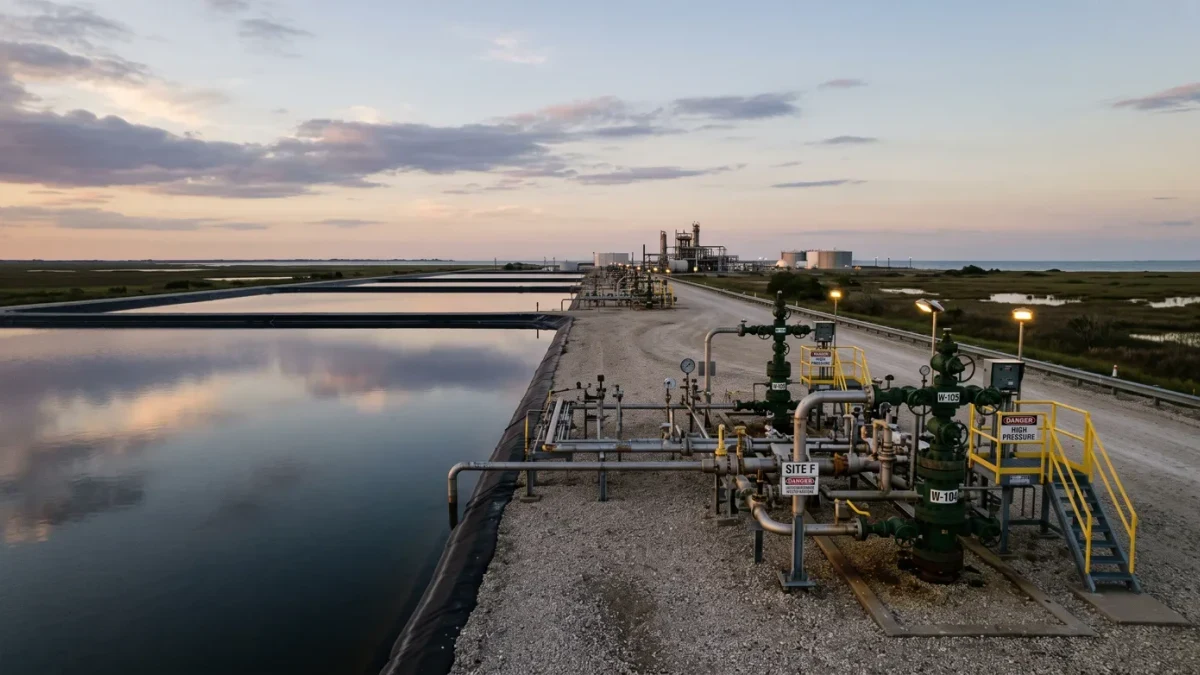
The Strategic Petroleum Reserve is the United States' emergency crude-oil stockpile: about 700 million barrels stored in deep salt caverns at four Gulf Coast sites in Texas and Louisiana, owned by the federal government and managed by the Energy Department. Created by the 1975 Energy Policy and Conservation Act after the Arab oil embargo, it has been drawn down three times at grand scale — the 1991 Gulf War release of about 34 million barrels, the 2011 Libya-crisis coordinated release of 60 million barrels with the IEA, and the 2022-2023 Ukraine-war sales of about 180 million barrels that brought inventories from about 590 million to roughly 350 million barrels, the lowest in four decades. Restocking has been partial: repurchases through 2024-2025 brought the reserve back toward 400 million barrels, with the 2025 refill pace slowed by price and budget politics.
How does a release actually work?
The statute distinguishes draws. Emergency drawdown — for a severe energy supply interruption, requiring presidential determination — the 1991 and 2011 events. Exchange — the routine tool: the SPR lends oil to refiners after hurricanes, taking repayment later with a premium — the small-volume pattern used after Harvey in 2017 and every Gulf storm season. Test sales — limited exercises of the system. And mandatory sales — congressionally mandated drawdowns to fund budgets, which produced tens of millions of barrels of sales across the 2015-2020 era and drained the reserve before the strategic releases arrived. The physical mechanics: crude sits in caverns and is pumped out to pipelines and marine terminals; maximum drawdown capacity is about 4.4 million barrels a day, reached within about two weeks of a decision, and it takes about 13 days from order to first barrels to market.
What did the 2022-2023 release do?
The record test. From March 2022 through 2023, coordinated with smaller IEA member releases, the administration sold about 180 million barrels — roughly a million barrels a day at peak — as oil spiked past 120 dollars after the Ukraine invasion. Effects, per the Energy Information Administration's analyses and outside studies: prices fell measurably — estimates center on several dollars a barrel and reduced gasoline prices by roughly 10 to 40 cents at the release's height — against the counterfactual debate about how much. The costs: inventories fell to the 350-million-barrel range, narrowing the buffer for a genuine supply emergency, and the refill — buying back at what critics noted were not always better prices — proceeded slowly through 2024-2025 fixed-price contracts the DOE structured to avoid moving markets against itself.
What is the reserve for, in doctrine?
The IEA framework: member states hold 90 days of net imports, deployed in coordinated releases for supply disruptions — the system's purpose is bridging interruptions, not managing prices. The 2022 episode stretched the doctrine toward price management — justified as addressing the supply disruption of the sanctions shock — and the debate is now structural: with U.S. net imports near zero — the shale era made the United States a net exporter — the classic import-interruption rationale has weakened, while the reserve's geopolitical role as a price weapon against producer coercion has strengthened. The 2023-2025 proposals — refill mandates, a fixed-price floor for repurchases at about 79 dollars a barrel, regional product reserves for gasoline and diesel — are Congress and the department arguing over which doctrine to encode.
What are the standing critiques?
Three. Scale and depletion: 350-400 million barrels covers fewer weeks of consumption than the reserve's historical norm, a vulnerability both parties have criticized from opposite directions. Politicization: every release lands in an election cycle's argument — the 2022 release's timing, the slow 2024-2025 refill's price politics — eroding the buffer's image as crisis insurance. And physical aging: the caverns, pipelines, and terminal infrastructure date from the 1970s-90s; the DOE's own modernization reviews flag dehydration and pressure maintenance projects needed to sustain drawdown capacity, work funded in fits through annual budgets. The analysis: the SPR has become a policy instrument held by a government that no longer faces the import dependency it was built for — the release-and-refill cycle now functions as a state trading operation in oil, buying low politically if not always financially, and its strategic value is set by the next disruption's shape: a Gulf hurricane is what exchanges handle; a Gulf war closure is what the buffer is for. What would change the reading is a statutory doctrine defining price-defense authority, which the 2023-2025 bills pursued without enactment.
Frequently asked questions
What is the Strategic Petroleum Reserve?
About 700 million barrels of federal crude in Gulf Coast salt caverns — roughly 400 million as of 2025 after the 2022-2023 releases and partial refill — created in 1975 after the oil embargo and managed by the Energy Department for emergency drawdown, exchanges, and mandated sales.
When has the SPR been released?
Emergency-scale releases: 1991 Gulf War, about 34 million barrels; 2011 Libya crisis, 60 million coordinated with the IEA; 2022-2023 Ukraine shock, about 180 million barrels — the largest ever. Routine hurricane exchanges happen most storm seasons.
Can a president release SPR oil to lower gas prices?
A release requires statutory grounds — severe supply interruption or exchange authority — and the 2022 release stretched that framing to the sanctions shock. Price effects are real but modest: studies put the gasoline impact at roughly 10 to 40 cents at the peak release rate.
How fast can SPR oil reach the market?
Physical capacity is about 4.4 million barrels per day, achievable within roughly two weeks of a decision, with first barrels to market in about 13 days — the fastest large-scale supply tool any government holds.