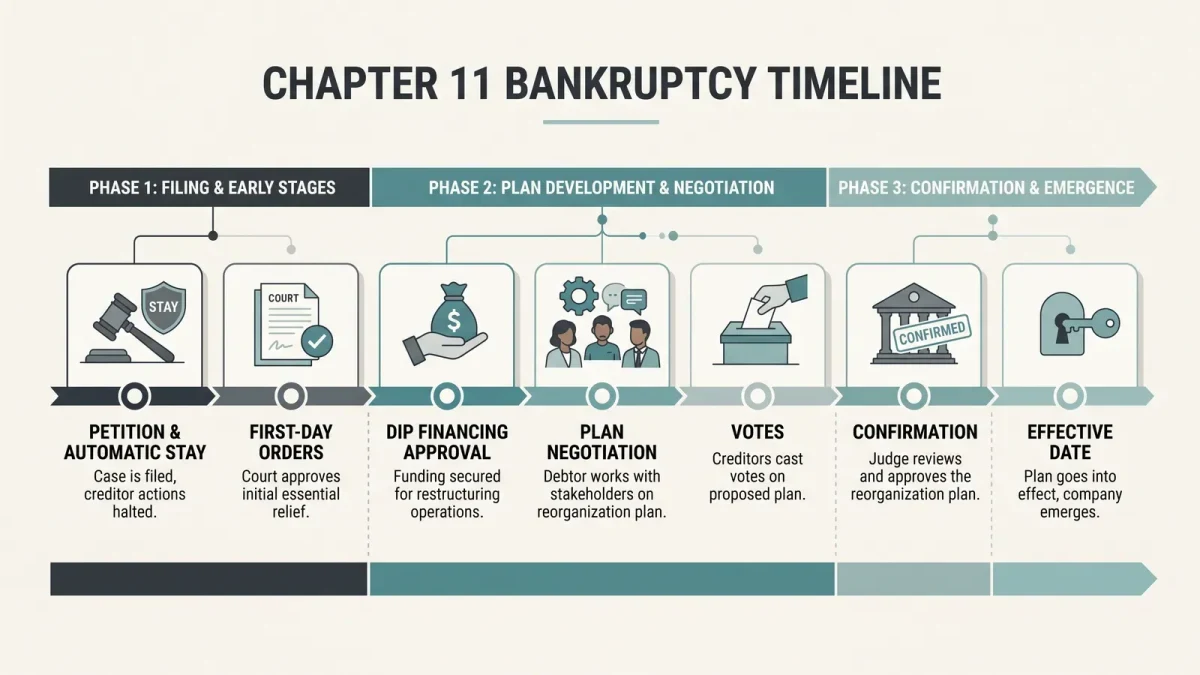
Chapter 11 of the U.S. Bankruptcy Code is the reorganization proceeding for companies that cannot pay their debts as they come due: the business keeps operating under court supervision while creditors negotiate a restructuring that a judge confirms as a plan. The stakes: U.S. corporate bankruptcy filings ran around 6,900 in calendar 2024 per S&P Global Market Intelligence counts, with 120-plus companies over 100 million dollars in liabilities, including retail chains, healthcare systems, and crypto estates. The median large case resolves in 12 to 18 months from filing to plan confirmation, with mega-cases — the 2021-2023 crypto collapses, the private-equity retailer waves — running longer. Reliable News publishes information, not investment or legal advice; this explainer covers the machinery.
What happens on day one?
The petition, filed in a U.S. district's bankruptcy court — Delaware and the Southern District of New York dominating large cases — triggers the automatic stay: every collection action stops. The debtor-in-possession keeps running the company; existing equity's control is preserved in name, but board duties now run to the estate. First-day motions seek approval to pay critical vendors and employees, and cash collateral or DIP financing — new senior loans that fund the case, typically 5 to 10 percent-plus rates with fees. The creditors' committee forms — usually the seven largest unsecured creditors elected under section 1102 — with lawyers paid by the estate, and the U.S. Trustee polices procedure.
How are creditors ranked?
The absolute priority rule, the code's spine. Secured claims take their collateral's value first. Then priority claims — wages up to caps, taxes. Then unsecured claims by seniority: senior notes before subordinated, general trade alongside. Equity holders come last, and in a case where unsecureds are not paid in full, old equity is usually cancelled — the equity-wipeout that distinguishes reorganization from a Going Concern sale. Sections of the code let parties contract around the edges — intercreditor agreements, subordination provisions — but deviations from priority need class consent or specific statutory hooks, the battleground of every plan fight.
What is the plan?
The deal document: who gets what — new debt, cash, equity, or a mix — and who owns the reorganized company, which in a typical case is the senior creditors converting debt to equity. The 2009 Chrysler and GM cases remain the famous deviations, where secured lenders recovered less than arithmetic suggested while supplier and union claims were protected, on public-policy grounds upheld by courts amid controversy. Plan confirmation requires voting by classes of creditors — acceptance by two-thirds in amount and one-half in number of voting classes — plus section 1129's crambdown alternative, and every distribution traces to the disclosure statement the court approves for voting. Exclusivity — the debtor's 120-day sole right to file a plan, extendable — frames the negotiation calendar.
What are the recurring pathologies?
Professional fees first: the estate pays lawyers, bankers, and restructuring advisers at rates that in mega-cases exceed hundreds of millions — the Lehman and Caesars cases set the records — a wealth transfer from creditors that fee examiners audit and courts approve anyway. Forum competition: Delaware and Texas and New York compete for filings, and venue doctrine debates recur. Cramdown fights and release provisions — nonconsensual releases of claims against third parties, blessed in some circuits and struck by the Supreme Court's 2024-2025 rulings limiting nonconsensual third-party releases — reshape who can be sued afterward. And private-equity structures create the era's signature problem: liability-management exercises pre-bankruptcy — uptiers and drop-downs — that move collateral away from existing lenders, litigated in the 2023-2025 cases as fraudulent-transfer and good-faith disputes.
Who wins and who loses?
The secured recover; trade creditors take discounts; employees' claims are mostly paid through the priority caps; pensions move to the Pension Benefit Guaranty Corporation when plans terminate, with the agency's deficits absorbing the difference; equity is usually wiped out, the retail-investor lesson of every cycle. The analysis: Chapter 11 is a machine for converting debt to ownership under judicial supervision while keeping the enterprise alive — its priority rules are old and stable, but its center of gravity has moved toward prepackaged and prenegotiated filings, where the deal is struck before the petition and the court proceeding ratifies it, moving power from judges to the deal lawyers; the 2024-2025 third-party-release decisions are the Supreme Court's push back on that drift. What would change the reading is comprehensive code reform addressing liability management, proposed repeatedly in the 2023-2025 cycles without enactment.
Frequently asked questions
What is Chapter 11 bankruptcy?
A court-supervised reorganization: the company keeps operating as debtor-in-possession, collections stop under the automatic stay, and creditors vote on a plan dividing the reorganized business's value by priority. Median large cases run 12 to 18 months.
Do shareholders get anything in Chapter 11?
Usually no. Under absolute priority, equity is cancelled unless unsecured creditors are paid in full — the rare solvent-company case. Recoveries concentrate in senior creditors converting debt to new equity.
What is DIP financing?
Debtor-in-possession lending: new money advanced during the case with super-priority over existing debt, approved by the court. It funds operations and, in practice, gives the DIP lender heavy influence over the case's direction.
What changed with third-party releases?
The Supreme Court's 2024-2025 decisions barred confirming plans that release claims of nonconsenting third parties — ending the practice of shielding insiders and sponsors from creditor suits through plan language, and sending such fights into class opt-outs and consent mechanics.