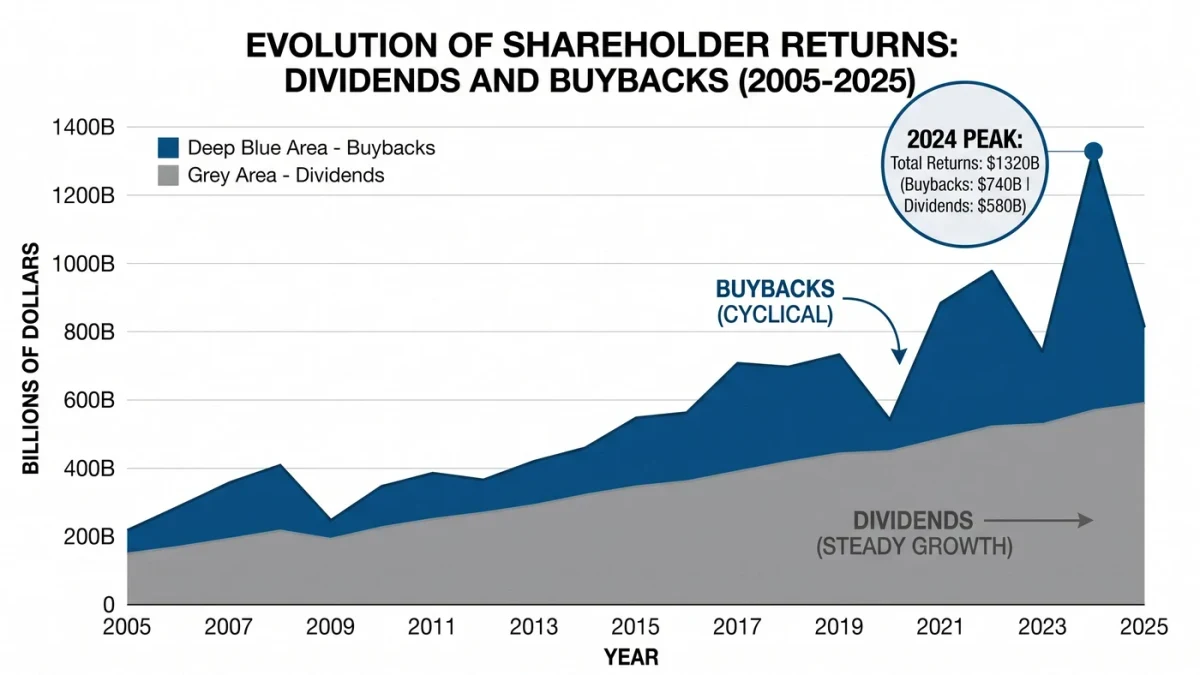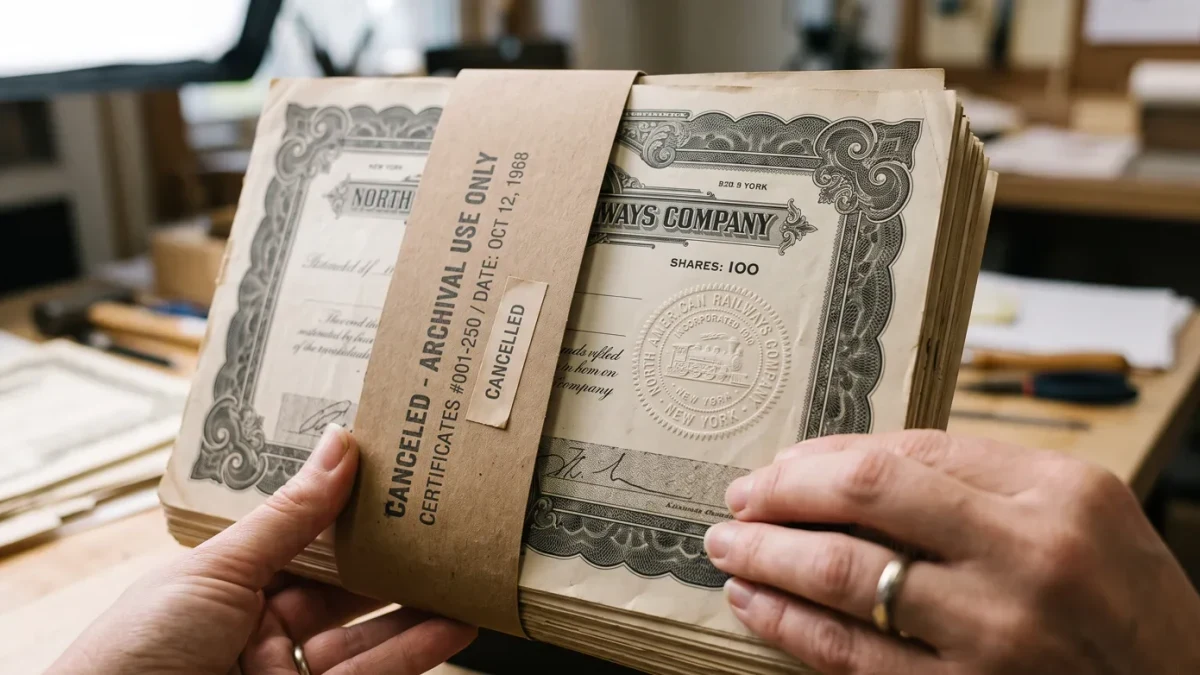
A share buyback is a company using cash to repurchase its own stock, retiring or holding the shares as treasury stock, which concentrates ownership and lifts earnings per share arithmetically. S&P 500 companies repurchased about 942 billion dollars of their own stock in 2024, per S&P Dow Jones Indices' buyback reports — a record year alongside roughly 600 billion dollars of dividends — with Apple alone buying back about 100 billion dollars under its authorization. Buybacks passed dividends as the dominant payout channel in the 2000s and have stayed there. Reliable News publishes information, not investment advice; this explainer covers the mechanics, the economics, and the regulatory fight.
How is a buyback actually executed?
Two ways. Open-market repurchases: the company buys at market prices under a board authorization, announced publicly but executed over months through brokers, subject to Rule 10b-18's safe harbor — volume, timing, and price limits that protect against manipulation appearance. Accelerated share repurchases and tender offers: the company contracts for or bids a fixed block at once, faster and costlier. Since 2023, the Inflation Reduction Act's 1 percent excise tax applies to net repurchases — buybacks minus new share issuance — raising the federal cost of the channel modestly. Executives' own trading during buyback windows is restricted by insider-trading rules and 10b5-1 plans, a compliance point SEC enforcement has tested.
What do buybacks do to the company?
Mechanically: fewer shares outstanding, so each remaining share claims more of the same profit stream — EPS rises with no operational change. The balance sheet gives up cash and equity; leverage ratios rise as equity shrinks, which is why buyback-heavy balance sheets drew attention in the pandemic and the 2023 rate shock, when some large repurchasers issued debt soon after. Signaling: announcements are read as management's view that the stock is undervalued, and event studies find announcement-day abnormal returns of about 2 percent on average — though execution data show companies buying more when prices rise, the opposite of value timing.
Why do critics want them restricted?
The redistribution argument: buybacks send cash to shareholders — disproportionately wealthier households — rather than into wages, R&D, or capacity. The short-termism argument: executives paid in EPS-linked compensation can meet targets mechanically by shrinking share count, and the SEC's own 2020-2023 policy debates cited buybacks' incentive distortion. The market-power argument: some studies — the influential 2020-2022 research on airline and pharma roll-ups — link buyback-funded serial acquisitions to concentration. The counter-evidence: payouts of any form are returns of cash the firm cannot invest at its cost of capital; dividends would face the same critique, and the dividend-substitution record shows total payout ratios have been roughly stable while the mix shifted toward repurchases' tax-and-flexibility advantages.
What have regulators actually done?
A 1 percent excise tax on net repurchases from 2023 under the Inflation Reduction Act — the first federal levy on the channel. SEC disclosure: the 2023 rule requiring daily repurchase disclosure quarterly — amounts, prices, and whether executives traded alongside — replacing the old monthly aggregate. Rule 10b-18 itself, unchanged in substance since 1982, continues to define the safe harbor. And repeated legislative proposals — from the 2018 Rubio-Casey bill through the 2024-2025 cycle's ban-and-condition ideas — to prohibit buybacks at companies with layoffs, federal contracts, or concentration risk; none enacted. The Democratic platform positions of the 2024 cycle endorsed conditioning buybacks on worker investment; the legislative arithmetic has not followed.
Who is right?
The sourced record supports narrower claims than either side's rhetoric. Buybacks do not mechanically cause underinvestment — R&D and capex rose alongside record buybacks in the 2010s-2020s — but they do amplify leverage choices, and the EPS-incentive channel is real where compensation plans are unadjusted for share count. The 1 percent tax's early evidence suggests volume elasticity is low: 2024's record came after the tax took effect. The analysis: the buyback fight is really a fight about corporate governance — whose claim on cash comes first when a firm has more money than projects — and the instrument survives because it is the payout form shareholders prefer and regulators can only tax, not define, optimal capital allocation. What would change the reading is a statutory ban or a conditions-based prohibition passing, which would shift the flow back to dividends with the same cash leaving the firm.
Frequently asked questions
Why do companies buy back their own stock?
To return cash to shareholders and shrink the share count, lifting earnings per share; to signal management's view that shares are undervalued; and to offset dilution from employee equity awards. S&P 500 repurchases hit about 942 billion dollars in 2024.
Are buybacks taxed?
Yes, at two layers: shareholders pay capital gains when they sell into the buyback or realize gains — unlike dividends, no immediate tax for holders who do not sell — and since 2023 companies pay a 1 percent excise tax on net repurchases under the Inflation Reduction Act.
What is Rule 10b-18?
The SEC safe harbor from manipulation liability for open-market repurchases, in force since 1982, setting volume, price, and timing limits. Since 2023 companies must also disclose daily repurchase data quarterly, including executive trading during programs.
Do buybacks hurt workers or investment?
Contested. Total payouts' share of profits has been roughly stable with the mix shifting to buybacks, and R&D rose during record buyback years. The documented harms concentrate in leverage choices and EPS-linked pay incentives, the basis of recurring legislative proposals to condition or ban repurchases.