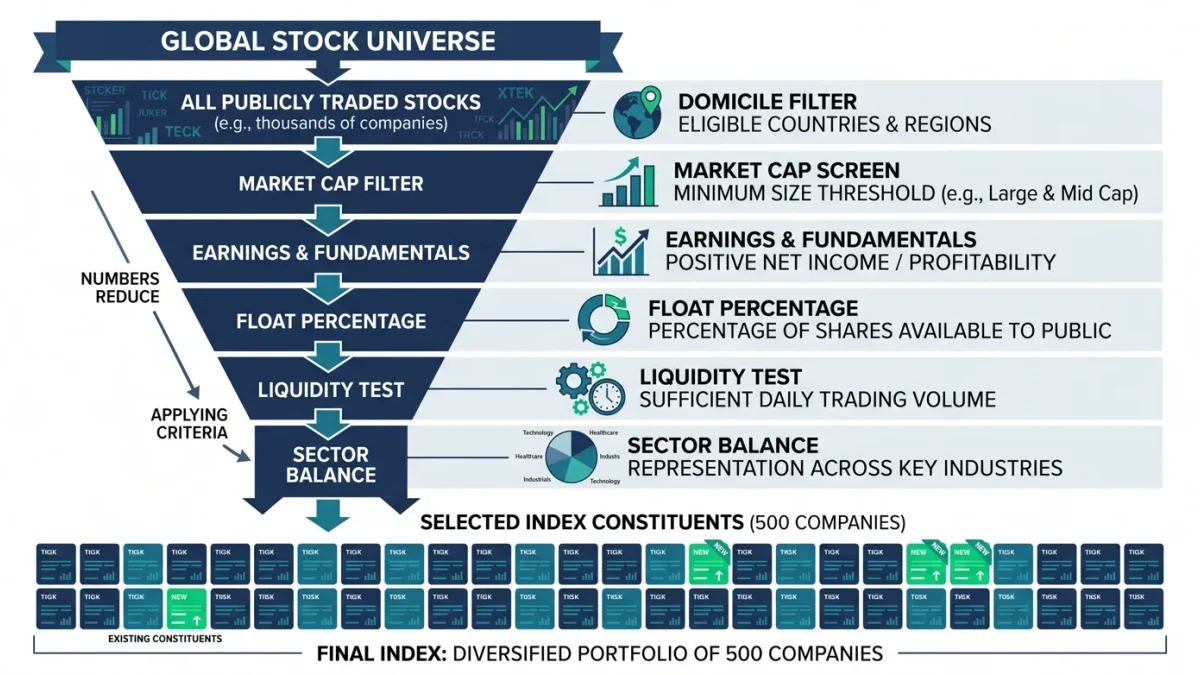
Major stock indexes are curated. The S&P 500's membership is decided by the U.S. Indices Committee at S&P Dow Jones Indices — a small panel meeting monthly behind closed doors — applying published criteria: U.S. domicile, market capitalization above 20.5 billion dollars as of the 2024 update, positive trailing earnings over four quarters combined, adequate liquidity and float, and sector balance. The index is not the 500 largest stocks by market value; it excludes some bigger companies — Berkshire Hathaway sat outside for years on float and liquidity considerations historically — and includes smaller ones the committee judged representative. Inclusion is an event: when a stock joins the S&P 500, index-tracking funds holding over 11 trillion dollars in assets benchmarked to S&P indexes must buy it, and the announcement-day and effective-day volume spikes are a documented market phenomenon.
What are the criteria, exactly?
S&P's published methodology for U.S. indices requires: primary domicile in the United States by asset and revenue location; a float-adjusted market cap in the top tier, with the committee's working threshold raised to 20.5 billion dollars in 2024; positive GAAP earnings summed over the four most recent quarters and the most recent quarter; public float of at least 10 percent; and trading characteristics — dollar volume, price history — the committee judges adequate. Sector balance is a live factor: the committee considers each industry group's weight against the economy. The Nasdaq-100's rules are purely rules-based — the largest non-financials on Nasdaq by market cap, annualized reconstitution in December — which is why additions there are predictable and S&P additions carry committee-judgment risk.
What happens when a company is added?
The announcement names the addition and deletion, usually after the close, with effective date days later. On the effective close, passive funds trade the rebalance — the volume spike concentrates in the closing auction, where added stocks can trade hundreds of millions of shares in minutes, and event studies document announcement-day abnormal returns of a few percent that partially reverse over following weeks. Tesla's December 2020 inclusion, the largest added weight in years, moved its price for weeks. The Russell reconstitution each June is the calendar's biggest rebalancing event, its additions and deletions published in advance by FTSE Russell.
Why do committees matter in an algorithmic age?
Because indexes are products, not measurements. S&P Dow Jones Indices earns licensing fees from the funds and derivatives tracking its indexes, and the committee's judgment — sector representativeness, a company's durability, financial quality — is the brand. The judgment has history: the committee removed airlines after bankruptcies on earnings criteria, readmitted them years later, and its 2023-2024 debates over adding media and payments companies shaped sector weights. The Dow Jones Industrial Average, the oldest curated product, uses a price-weighted formula with a selection committee of S&P and Wall Street Journal representatives choosing 30 blue chips — a method vestige from 1896 that makes high-priced stocks mechanically dominant regardless of size.
What are the honest criticisms?
Three. Momentum loading: because eligibility requires positive earnings and scale, the S&P 500 systematically admits companies after they have grown and drops them after trouble — buying high, selling low, relative to the universe, a lag the committee acknowledges as the cost of quality screens. Concentration: the top ten constituents reached about 38 percent of index weight in late 2024-2025, so capitalization weighting makes the index a momentum bet on mega-cap technology — the anti-concentration complaint of every cycle's late stage. And index-fund herding: over 11 trillion dollars benchmarked to S&P products means committee decisions move markets mechanically, which is why index inclusion studies document durable price effects — the literature since Shleifer's 1986 S&P inclusion study found permanent effects once indexing grew.
Who checks the committees?
Methodology documents and, in some jurisdictions, regulators. S&P publishes its criteria and announces changes with rationales; IOSCO's principles for financial benchmarks — written after the LIBOR scandal — govern index governance, with conflicts managed by separation of the index business from data businesses; and futures on the indexes are CFTC-regulated, giving the committee's product public consequences. The analysis: an index committee is one of the quiet consequential powers in markets — a private panel's judgment, published as criteria but applied as discretion, allocating trillions of passive capital's flow — and its existence is the strongest argument that even rules-based finance keeps human selection at the load-bearing joint. What would change the reading is pure rules-based S&P 500 construction, which S&P has declined to adopt for quality-control reasons it has stated.
Frequently asked questions
How does a company get into the S&P 500?
The S&P U.S. Indices Committee selects it against published criteria — U.S. domicile, 20.5-billion-dollar-plus market cap as of the 2024 threshold, positive trailing earnings, sufficient float and liquidity, sector balance. It is a committee choice, not an automatic size ranking.
Does joining the S&P 500 raise a stock's price?
Usually at first: index funds must buy the new member, driving announcement-day gains of a few percent on average, with partial reversal later — though large additions like Tesla in 2020 showed more durable effects as passive ownership rose.
What is the difference between the S&P 500 and the Nasdaq-100?
The S&P 500 spans exchanges with committee selection on quality screens; the Nasdaq-100 is rules-based — the largest Nasdaq non-financial stocks by market cap, reconstituted annually. One is curated, the other computed.
Why is the Dow so different from the S&P 500?
The Dow is 30 committee-picked blue chips in a price-weighted formula from 1896, so share price, not market value, sets influence. The S&P 500 is float-cap-weighted across 500 names, a truer size measure.