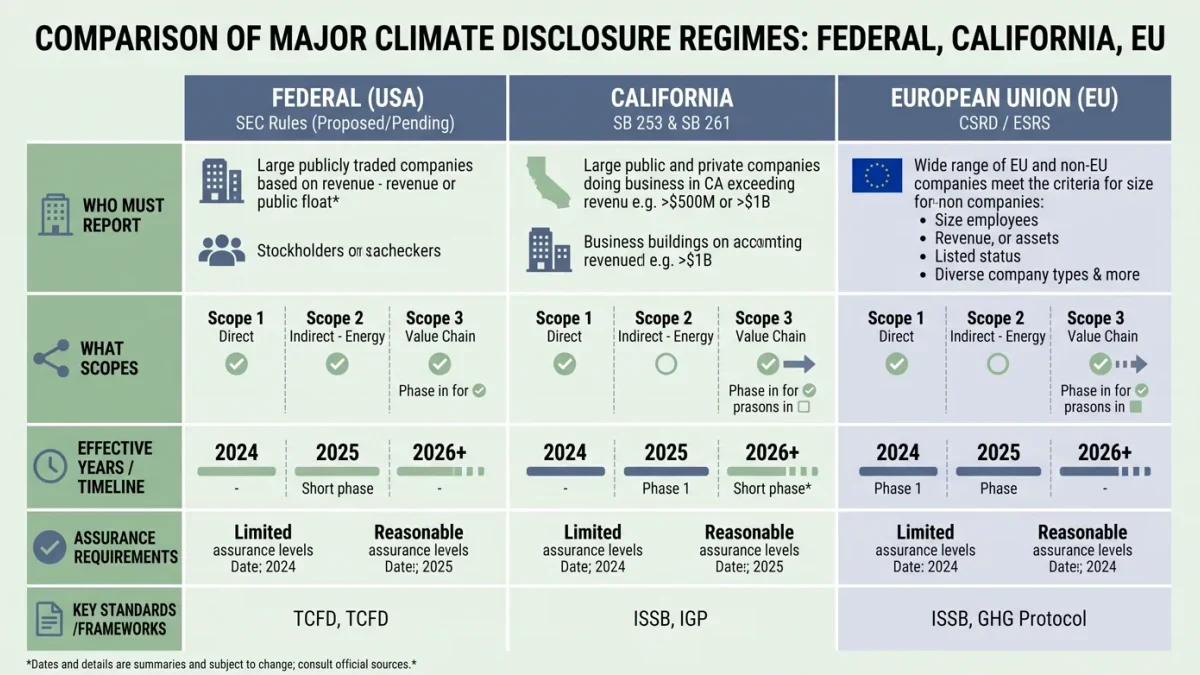
Corporate climate disclosure in the United States is a three-jurisdiction patchwork. The SEC adopted its climate disclosure rule in March 2024 — requiring large public filers to report material climate risks and, for the largest, Scope 1 and 2 greenhouse-gas emissions — then stayed it amid consolidated litigation and, in 2025, voted to end its defense of the rule, leaving federal mandatory climate reporting effectively dead for now. California filled the gap: SB 253 and SB 261, signed in 2023 and taking effect on staggered 2026 timelines, require companies doing business in California above revenue thresholds — over 1 billion dollars for SB 253's emissions reporting, 500 million for SB 261's climate-risk reports — to disclose Scope 1, 2, and, from 2027, Scope 3 emissions. And Europe's Corporate Sustainability Reporting Directive reaches U.S. companies with significant EU operations, exporting the EU's detailed reporting standards across the Atlantic. The net result: thousands of U.S.-based companies are preparing to file climate data somewhere, regardless of the SEC's retreat. Reliable News publishes information, not investment or legal advice.
What did the SEC rule actually require?
The March 2024 rule, as adopted: disclosure of material climate-related risks and their financial effects — costs, impairments, insurance — plus governance and risk-management processes; for large accelerated and accelerated filers, Scope 1 and 2 emissions reporting if material, phased from fiscal 2025 reports; and, in the final rule, the retreat from the proposal's Scope 3 and financial-statement line-item requirements that had drawn the bulk of industry comment. Litigation consolidated in the Eighth Circuit produced the stay, and the commission's 2025 posture — withdrawing its defense and proposing rescission — is the formal unwinding. The rule never took effect; the anti-washing rule against misleading sustainability claims remains the SEC's active tool.
What do California's laws cover?
SB 253, the Climate Corporate Data Accountability Act: Scope 1 and 2 emissions disclosure starting 2026 for companies over 1 billion dollars in revenue doing business in California, assured at limited level initially; Scope 3 from 2027 at reasonable assurance, with the Air Resources Board as regulator and CARB's 2025 implementing regulations clarifying scope. SB 261: biennial climate-risk reports aligned to TCFD-style frameworks for companies over 500 million dollars, first due January 2026. The constitutional fights — dormant commerce clause challenges by the U.S. Chamber and industry coalitions — produced an early federal ruling largely sustaining the laws, with Scope 3 timing still contested. Coverage is broad: the revenue test, not incorporation or headquarters, pulls in thousands of public and private companies, from tech to retail to energy.
What reaches from Europe?
CSRD, in application from fiscal 2024 reports for the first wave of large EU companies, extends to non-EU companies with over 450 million dollars of EU turnover and an EU presence from fiscal 2027-2028: U.S. multinationals will file under the European Sustainability Reporting Standards — double-materiality assessments, workforce, supply-chain, and emissions data at detail beyond any U.S. regime. The EU's 2025 omnibus simplification trimmed scope and delayed waves, but the direction survived: large U.S. issuers with European operations will report to Brussels' standards. The EU's battery regulation, deforestation rules, and carbon border mechanism add product-level duties that importers meet with the same data infrastructure.
What does this mean practically for investors?
Comparability is arriving unevenly. The global baseline — the ISSB's IFRS S1 and S2 standards, adopted or being adopted across dozens of jurisdictions — anchors most non-U.S. rules; California's framework borrows GHG Protocol accounting; the SEC's retreat leaves the U.S. without a federal anchor. Investment-side rules run parallel: the SEC's 2023-2024 fund-naming and ESG-washing enforcement set disclosure duties for funds marketing sustainability; state anti-ESG statutes — Texas, Florida, and others restricting consideration of sustainability factors — created the counter-current that shaped the political fight. Data users get assurance-backed emissions numbers from California filings, TCFD-style risk reports, and EU-standard reports for multinationals — an aggregation that data providers already stitch together.
Where does this settle?
The analysis: the U.S. federal retreat did not stop mandatory climate disclosure — it relocated it. California's market size and the EU's extraterritorial reach mean the marginal large company now builds one reporting stack serving Sacramento and Brussels, and the SEC's own voluntary-disclosure framework — Regulation S-K's materiality principles — still governs what climate risks public filers must disclose under existing law. The litigation ledger is the open variable: California's challenges narrowed but did not kill the laws; a hostile ruling on Scope 3 could delay the most contested layer again. What would change the reading is congressional preemption of state climate rules — proposed repeatedly without success — or the SEC re-adopting a narrowed rule, either of which would redraw the map that companies are currently building against.
Frequently asked questions
Do U.S. companies have to disclose emissions now?
Federally, no — the SEC's 2024 climate rule was stayed and is being rescinded. But California's SB 253 requires Scope 1 and 2 disclosure from 2026 for companies over 1 billion dollars in revenue doing business there, with Scope 3 from 2027, and EU rules reach large U.S. multinationals from 2027-2028.
What is the difference between Scope 1, 2, and 3 emissions?
Scope 1: direct emissions from owned operations. Scope 2: purchased energy's emissions. Scope 3: everything up and down the value chain — suppliers, products' use — typically the largest and least precise category, and the one California phases in from 2027.
What happened to the SEC climate rule?
Adopted March 2024, stayed in consolidated Eighth Circuit litigation, and left undefended by the commission in 2025, which moved to rescind it. It never took effect; existing materiality rules and the anti-greenwashing rule still apply.
Which companies must file under California's laws?
SB 253: over 1 billion dollars in annual revenue doing business in California — Scope 1 and 2 from 2026. SB 261: over 500 million — biennial climate-risk reports from January 2026. The tests reach public and private companies alike.