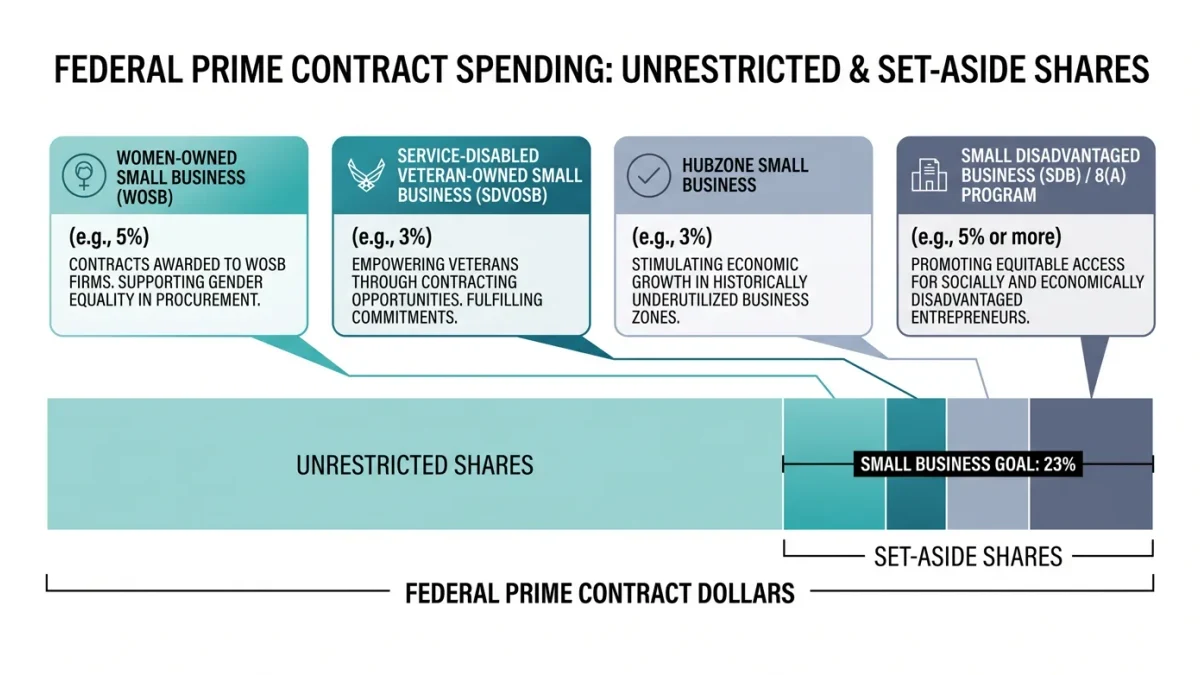
Set-asides are the federal procurement system's preference mechanism: contracting officers reserve competitions for small businesses, or categories of them, instead of opening bids to all comers. The statutory goal is that 23 percent of prime contract dollars go to small businesses, with sub-goals for women-owned, service-disabled-veteran-owned, historically underutilized business zone (HUBZone) firms, and small disadvantaged businesses — goals the government has recently exceeded, awarding about 28 to 30 percent of eligible dollars, roughly 180 billion dollars a year, per the Small Business Administration's federal procurement scorecards. The authority is the Small Business Act's Section 8(a) program and the competition rules of the Federal Acquisition Regulation's Part 19. This explainer covers how the preference system works and where it strains.
What qualifies a business as small?
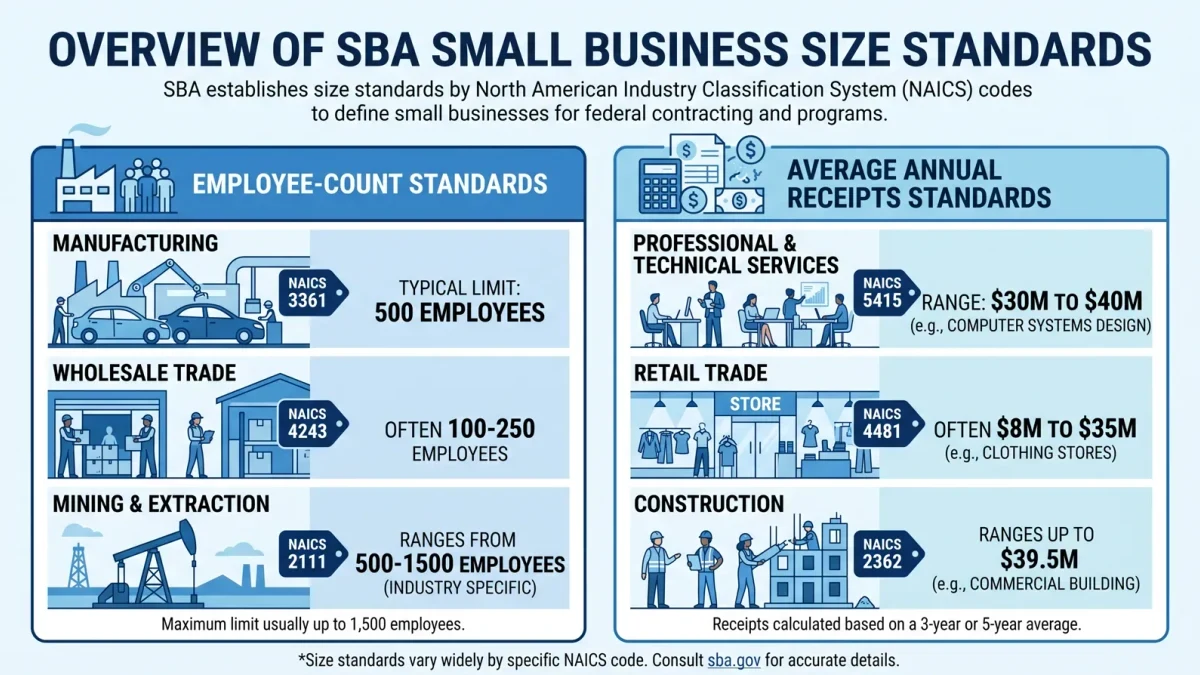
Size standards by industry, set by the SBA: either number of employees or average annual receipts, with receipt caps ranging from under 1 million to over 47 million dollars depending on the North American Industry Classification System code — manufacturing typically 500 employees, many services 8 to 25 million dollars averaged over five years. Ownership and control tests govern the socioeconomic categories: at least 51 percent unconditional ownership by women, veterans, or disadvantaged individuals, with control actually exercised. Size is self-certified at offer, and the SBA's size determinations come after the fact — which is where protests live.
How does a contract get set aside?
The rule of two: if the contracting officer reasonably expects at least two responsible small businesses will offer at fair market prices, the competition must be reserved for them. Set-asides can be total or partial — large primes carving out subcontracts to meet their own subcontracting plans. The 8(a) program's subset allows sole-source awards to socially and economically disadvantaged firms up to about 4.5 million dollars for goods and 7.5 million dollars for manufacturing-adjacent work — a sole-source channel that produced both thousands of successful firms and the system's recurring abuse cases. The Mentor-Protégé program lets small firms partner with large primes for past-performance credit, with joint-venture rules the SBA tightened after manipulation cases.
What are the abuse patterns?
Front companies — large firms using a nominally small or disadvantaged pass-through to win reserved work — are the recurring enforcement theme. The SBA's suspension and debarment actions, False Claims Act settlements, and Justice Department prosecutions cover cases where a large contractor supplied the workforce and management while the certified small business collected the preference. The bid-protest channel — the Government Accountability Office's protests and the Court of Federal Claims — polices size and eligibility in real time, with size protests resolved by SBA determinations that can un-award contracts. Self-certification at SAM.gov makes fraud cheap to attempt; verification regimes differ — veteran-owned firms self-certify while service-disabled status draws VA verification scrutiny, an asymmetry Congress has repeatedly addressed.
Do set-asides work?
For access, demonstrably: the small-business share of federal prime dollars roughly doubled after the preference architecture matured, and the scorecards show goals met government-wide in recent years. For outcomes, mixed: studies of HUBZone and 8(a) programs find entry effects but weaker evidence on firm growth and graduation — firms often staying under size caps or exiting the program, the small-business equivalents of benefits cliffs; and the Government Accountability Office's recurring reviews flag fraud risk and program-integrity gaps. The distribution question recurs too: a small set of firms captures a large share of 8(a) sole-source dollars, the pattern GAO reporting has documented across administrations.
What are the current pressures?
Spending politics: the 2025 reconciliation's procurement-related changes and the executive-branch efficiency drives targeted contract volume broadly, hitting set-aside-dependent firms hardest since small firms have less buffer — the small-business contracting community's standing complaint in drawdown cycles. Category management — buying through consolidated vehicles — squeezes small entrants out of commodity categories by design. And the procurement workforce's capacity: contracting officers' risk aversion after protests and fraud cases slows awards to new entrants. The analysis: set-asides are a deliberate market intervention that trades some procurement efficiency for distributional goals, and the record supports both sides — access achieved, graduation weaker, fraud policed but persistent; the system's honest evaluation is the SBA's own scorecards and GAO audits, which is where each year's verdict is written. What would change the reading is a statutory overhaul of size standards or category management's expansion past the point where the rule of two can operate, both live debates without enacted change.
Frequently asked questions
What is a small business set-aside?
A federal contract competition reserved for small businesses — or subcategories like women-owned, veteran-owned, HUBZone, or disadvantaged firms — when the contracting officer expects at least two qualified small bidders. Roughly 180 billion dollars a year flows through such awards.
What is the rule of two in contracting?
The requirement that a contract be set aside for small businesses when the contracting officer reasonably expects offers from at least two responsible small firms at fair market prices. It is the trigger for most small-business reservations.
What is the 8(a) program?
The SBA program for socially and economically disadvantaged firms, offering set-asides and sole-source awards up to set ceilings and a nine-year developmental track. It is the system's most powerful — and most litigated — preference.
How big can a small business be?
It depends on industry: SBA size standards range from under 1 million to over 47 million dollars in average annual receipts, or 100 to 1,500 employees for manufacturing and other codes. Certification is by NAICS code at offer time and can be protested after award.