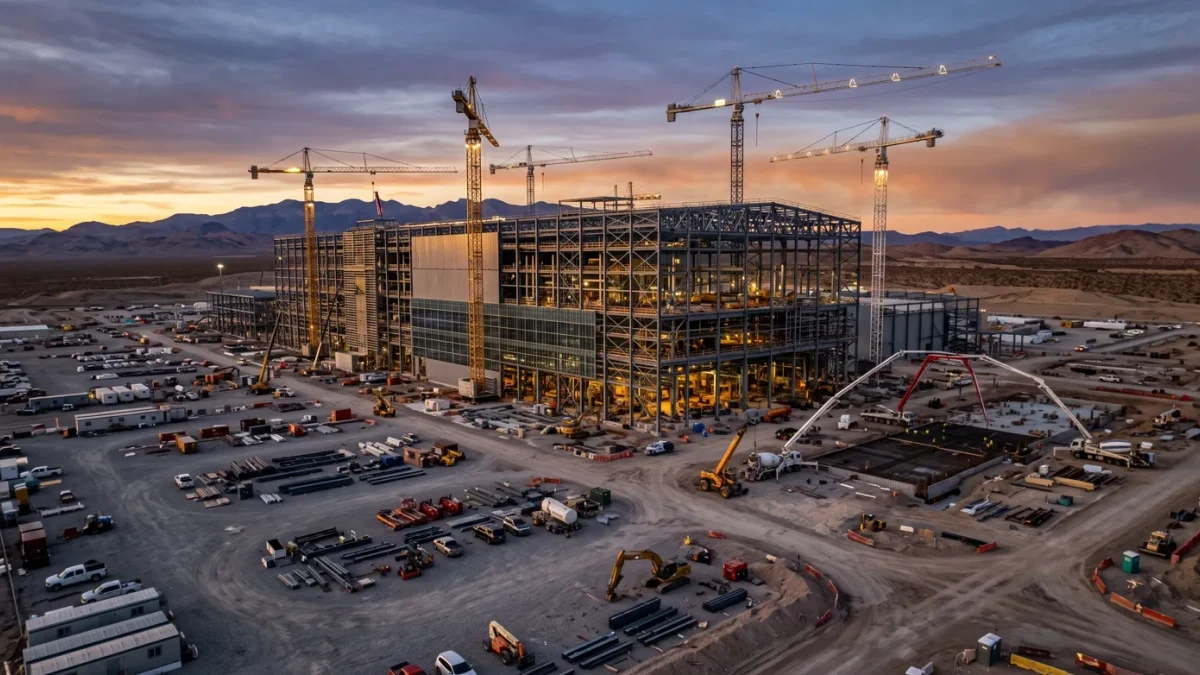
The CHIPS and Science Act of 2022 appropriated 52.7 billion dollars for the U.S. semiconductor industry — 39 billion in manufacturing incentives administered by the Commerce Department and about 13 billion for R&D and workforce — plus a 25 percent investment tax credit whose original estimate ran near 24 billion dollars. The result is measurable: over 450 billion dollars in announced private semiconductor investment across more than 90 projects, with construction concentrated in Arizona, Texas, Ohio, and New York, per Commerce Department award announcements through 2024-2025. Taiwan Semiconductor Manufacturing Company's Arizona complex — three fabs with a announced investment that grew to about 65 billion dollars — is the emblem: the most advanced chip manufacturing ever built on U.S. soil, sited where tax and water politics allowed. Reliable News publishes information, not policy advice; this explainer covers how the incentive machinery worked and what has happened since.
How did the awards work?
Different instruments for different purposes. Direct funding — grants covering typically 10 to 15 percent of project capital costs, structured as tranches released on construction and production milestones. Loans and loan guarantees through the CHIPS Program Office's credit window. And the investment tax credit — section 48D, 25 percent of qualified fab investment, claimed through 2026-2027 timelines. Awards came with standard conditions: upside sharing agreements entitling the government to recapture above-plan profits, restrictions on stock buybacks with award funds, childcare requirements for larger facilities — later loosened — and the guardrails: a decade of restrictions on expanding advanced capacity in countries of concern, principally China.
What did the money actually buy?
Capacity and geography. Before CHIPS, the United States fabricated about 10 to 12 percent of global logic capacity and none of the most advanced nodes; the Commerce milestone tracking through 2025 shows advanced production at TSMC Arizona and Intel's Ohio and Arizona sites moving toward the leading edge, with Samsung's Taylor, Texas, project delayed and rescheduled. The construction boom showed up in the data: the Census Bureau's manufacturing-construction spending series roughly tripled from 2022 to 2024, computer-and-electronic driving nearly all of it — one of the largest sectoral construction waves on record. The counterfactual dispute is live: critics note the same announcements clustered before awards, and that the tax credit alone, uncapped, would have pulled some projects regardless; Commerce's own defense is the milestone-based structure — no fab dollars without built fabs.
What are the guardrails fights?
The China restrictions. Recipients may not materially expand advanced semiconductor capacity in China for ten years — a condition that forced divestments and caps at legacy fabs owned by Intel, TSMC, and others in China, and generated the era's litmus-test cases. Export controls run in parallel: the October 2022 and December 2024 rules restricted equipment and high-bandwidth memory sales to China, aiming at AI-capable compute — a policy interlock with CHIPS subsidies that makes the incentive system effectively two-aisled: money to build here, controls to slow building there. The 2025 political turn tested the whole frame — personnel changes at Commerce reopened agreements and loosened some upside-sharing terms, and the guardrails' durability under litigation and renegotiation became the program's live question, with several 2025 renegotiations reported.
What did it cost per job?
The honest arithmetic is expensive by jobs-counted standards: construction employment at fabs peaked in the tens of thousands, with permanent operating jobs at major fabs in the thousands each — direct-funding cost per permanent operating job runs in the hundreds of thousands of dollars, the figure critics cite. The program's defense is not jobs but production: strategic capacity at leading nodes, supply-chain resilience measured in the share of advanced logic fabricable domestically, and the national-security case — chips are the input to weapons systems and AI compute — that the original statute's findings articulate. Evaluations of the defense-conversion value are inherently classified-adjacent and contested.
What happens next?
The tax credit does most of the remaining pulling: uncapped 25 percent credits claimed on projects through their timelines, dwarfing the grant pool. The milestone tranches continue releasing. And the global subsidy race the act joined — the EU Chips Act, Japan's Rapidus support, India's fab subsidies — continues setting the reference price for siting, with each jurisdiction's terms published and compared by every corporate siting committee. The analysis: CHIPS demonstrated that targeted subsidies move specific capital goods decisively when the check is large and milestone-bound — the geography of leading-edge fabrication visibly shifted toward the American Southwest in four years — and left two open ledgers: whether the operating economics survive without continued support, and whether the political framework that funded them stays bought. What would change the reading is a major recipient returning capacity abroad or the guardrails collapsing under renegotiation, either of which would mark the experiment's boundary.
Frequently asked questions
What did the CHIPS Act pay for?
39 billion dollars in manufacturing incentives as milestone-based grants and loans, about 13 billion for R&D and workforce, and a 25 percent investment tax credit. Awards covered roughly 10-15 percent of project costs, tied to construction and production milestones.
Which states won CHIPS fabs?
Arizona leads — TSMC's about 65-billion-dollar complex and Intel's expansion — followed by Texas, Ohio, and New York, with over 90 announced projects totaling more than 450 billion dollars in private investment through 2025.
What are the CHIPS guardrails?
Ten-year restrictions barring award recipients from materially expanding advanced semiconductor capacity in China, alongside parallel export controls on fab equipment and advanced chips. Violations can trigger clawback of federal funds.
Was the CHIPS Act worth it?
Contested. Cost per permanent job is high; the program's stated goal is strategic production — leading-edge fabrication capacity on U.S. soil — not employment, and by that measure advanced-node output in Arizona and Ohio is the deliverable. Operating economics without subsidy remain untested.