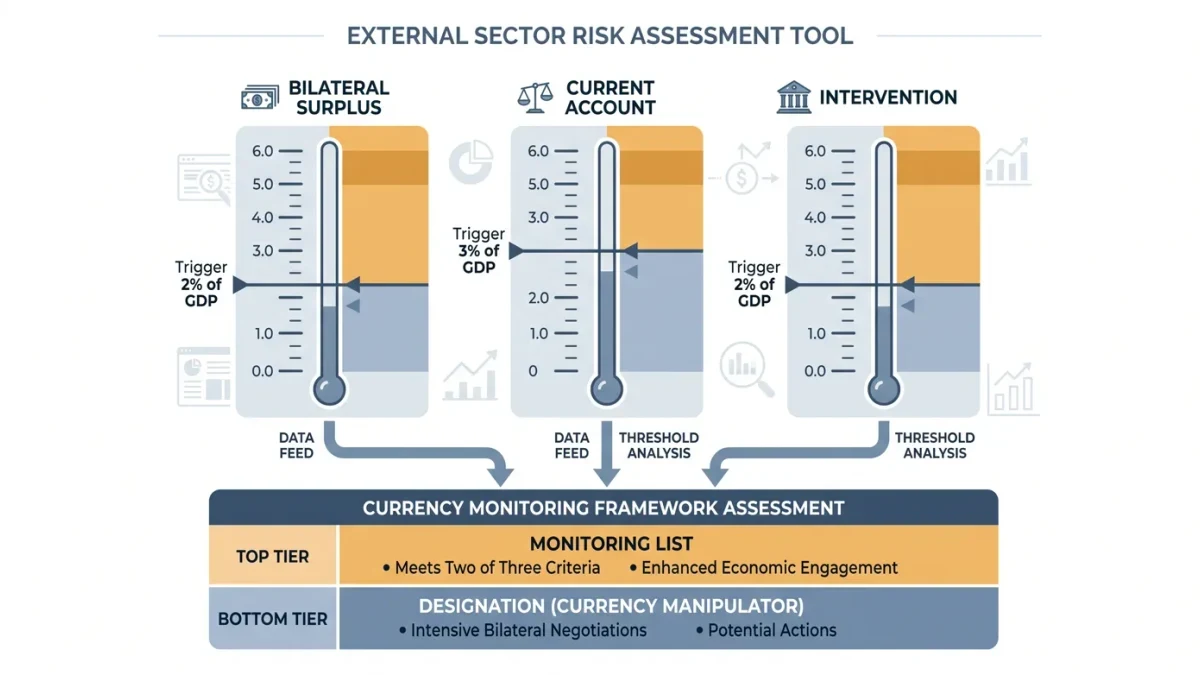
Currency-manipulation designation is the U.S. Treasury's semiannual judgment on whether trading partners artificially depress their currencies to gain trade advantage. The framework is the Trade Facilitation and Trade Enforcement Act of 2015, which set three materiality thresholds a Treasury report to Congress applies to each major partner: a bilateral goods surplus with the United States of at least 15 billion dollars; a current-account surplus of at least 2 percent of GDP; and persistent one-sided foreign-exchange intervention of at least 2 percent of GDP over a year. Meeting all three triggers enhanced analysis and engagement; meeting two puts a country on the monitoring list. The April 2025 report kept the usual roster — China, Japan, Korea, Taiwan, Germany, Italy, Singapore, Vietnam, and others — on the monitoring list, with no new manipulator designations since Vietnam and Switzerland's in December 2020, both rescinded within months under the Biden Treasury.
What happens to a designated country?
Procedurally: enhanced bilateral engagement, IMF consultation, and if the issue persists after a year, potential remedies the statute lists — exclusion from government procurement, OPIC — now the Development Finance Corporation — financing, and IMF opposition. Historically never applied in full: the designation's function has been diplomatic pressure with the penalty menu as backdrop. The cases bear this out — China designated in 2019 during the trade war, rescinded in January 2020 alongside the phase-one deal's currency chapter, which added enforceable transparency commitments; Switzerland and Vietnam designated December 2020 on intervention criteria, both negotiating adjustments and off the list by 2021. The tariff era changed the instrument's use: the 2025 trade conflict saw currency clauses — exchange-rate commitments and valuation complaints — embedded in deal texts, making the report a bargaining input rather than the verdict.
Why is the concept contested?
Because identifying manipulation is technically hard. Intervention is the clearest signal — sustained one-sided purchases of dollars to hold a currency down, visible in reserves and the Treasury's own estimates of intervention. But the current-account and bilateral-surplus thresholds describe savings and trade patterns that standard economics attributes mostly to fundamentals — demographics, fiscal position, oil imports — and the same criteria would flag Germany or Singapore, whose surpluses owe little to currency policy. The dollar's reserve role adds the deepest complication: global demand for dollar assets pushes the dollar up independent of U.S. policy, the exorbitant-burden argument that persistent deficit countries' complaints run against. Japan's 2024 interventions — buying yen as it fell past 160, the first since 1998 — illustrate the definitional wrinkle: supporting one's own currency draws no designation pressure at all, only the reverse side of the intervention criterion.
What did the era of tariffs do to it?
Blurred the instrument into trade policy. The 2019 China designation arrived mid-trade war and was resolved in the phase-one agreement's currency chapter — transparency, disclosure, restraint commitments — the model for later deals. The 2025 tariff rounds referenced undervaluation in justification texts, and the April 2025 Treasury report's monitoring-list expansion ran parallel to the negotiations. Meanwhile the substantive target has shifted from current-account surpluses to industrial policy: the era's real currency complaints — China's export machine, the yen's slide — are argued less through the 2015 thresholds than through subsidies and state-bank channels the framework does not reach.
Does the label matter anymore?
As theater with consequences: markets watch the report's dates, designated countries mobilize diplomacy, and the monitoring list itself disciplines behavior — Korea, Taiwan, and Switzerland trimmed intervention after appearances on it. But the strongest currency.alignments of the era — Japan's 2024-2025 yen defense, China's managed glide — sit inside the framework's blind spots, and the IMF's own external-sector reports do the more careful analysis without the designation machinery. The analysis: the 2015 statute codified a 1980s-Japan view of currency conflict — surplus countries depressing exchange rates for export share — while the current era's disputes run through capital flows, industrial subsidy, and sanctions architecture, where a bilateral goods surplus is a symptom, not a lever; the designation survives as a negotiating artifact precisely because its penalties were never meant to be used. What would change the reading is a statutory update tying designation to subsidy and state-credit behavior, which Congress has drafted without passing.
Frequently asked questions
What counts as currency manipulation?
Under the 2015 act's thresholds — a 15-billion-dollar bilateral goods surplus with the U.S., a current-account surplus above 2 percent of GDP, and persistent one-sided FX intervention above 2 percent of GDP — all three met triggers the label. Two of three earns the monitoring list. Treasury reports semiannually.
Which countries are on the monitoring list?
The April 2025 report's list included China, Japan, Korea, Taiwan, Germany, Italy, Singapore, Vietnam, Malaysia, and others. No country has been designated a manipulator since Vietnam and Switzerland in December 2020, both rescinded in 2021.
What are the penalties for designation?
Enhanced engagement and IMF consultation first; after a year, possible exclusion from federal procurement, loss of development-finance support, and IMF opposition — penalties never fully applied. The label's real force is diplomatic and market pressure.
Why isn't Japan's intervention counted?
Japan intervened in 2024-2025 to support the yen — buying its own currency — while the manipulation framework targets one-sided purchases of dollars to hold currencies down. Supporting your currency falls outside the designation's direction.