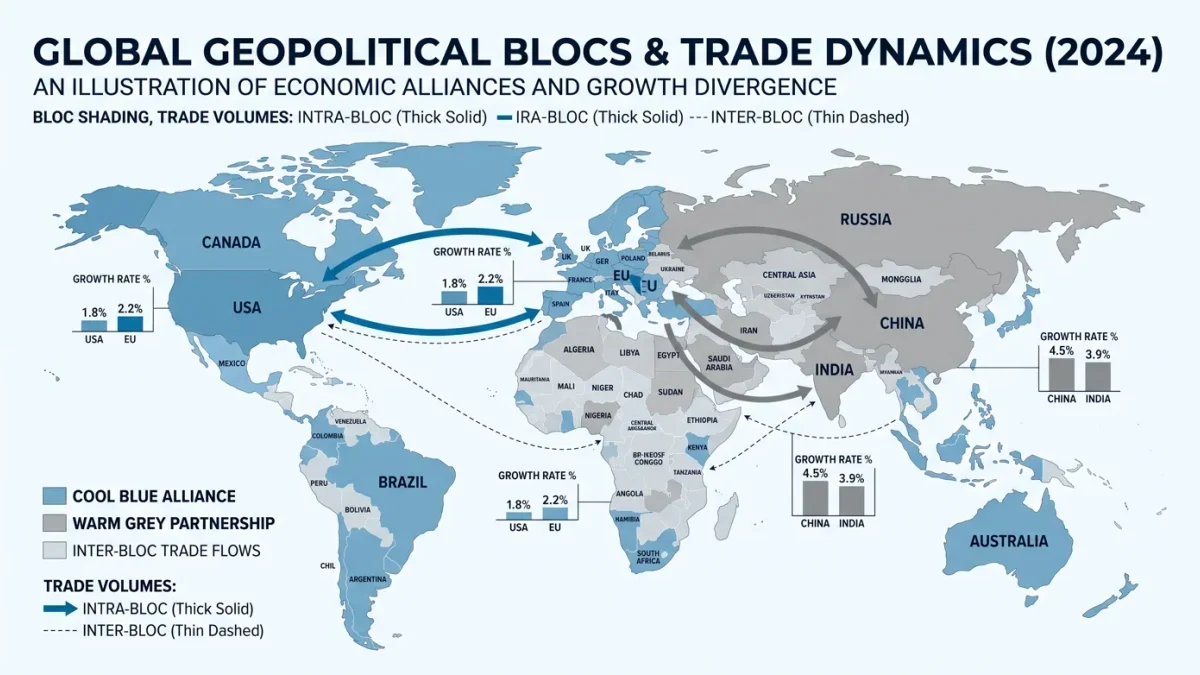
Friendshoring is the redirection of trade and investment from globally efficient locations toward allied or lower-risk ones — the corporate response to tariffs, export controls, sanctions, and pandemic-era shocks. The evidence it is happening is now statistical: IMF and WTO studies through 2024-2025 find trade between geopolitical blocs — roughly, the U.S.-aligned and China-aligned groups defined by UN voting patterns — growing measurably slower than trade within blocs, a fragmentation gap of several percentage points a year since 2022, even as total trade volumes kept growing. The direction of the flows: Mexico and Vietnam overtook China as the largest U.S. goods import sources in 2023-2024; U.S. imports from China fell from about 21.6 percent of goods imports in 2017 to around 13 percent by 2024, per Commerce data; and China's own trade rerouted through Southeast Asia, whose exports to the U.S. rose as its imports from China rose in near-lockstep — the transshipment signature.
What is actually moving?
Four categories. Low-margin assembly first — apparel, furniture, consumer electronics assembly — the sectors where tariff arbitrage beats relocation costs, moving to Vietnam, India, Bangladesh, Mexico. Strategic sectors second — semiconductors, batteries, pharmaceuticals, critical minerals — driven by subsidies as much as tariffs: the CHIPS act, the EU chips act, the IRA's battery rules with their content requirements, India's production-linked incentives. Double-supply third — the resilience playbook of running China-for-China and China-plus-one in parallel, which multinationals from Apple to Volkswagen have implemented, at the cost of duplicated capacity. And nearshoring to Mexico fourth — the USMCA's free lane making Mexico the largest U.S. trading partner from 2023, with auto and electronics investment announcements following, and 2025's tariff fights over USMCA-compliance carve-outs showing the framework's political fragility.
What does it cost?
The estimates are converging. The IMF's long-run scenarios put severe fragmentation — trade blocs with tech decoupling — at up to 7 percent of global GDP, with the realistic partial path already priced at 1 to 2 percent; the WTO's 2023-2025 estimates of a two-bloc split run similar, with developing economies outside the blocs losing most — the countries that gained from hyper-globalization now facing rerouted investment. Firm-level costs are concrete: duplicated capacity lowers utilization, tariffs add directly to input costs, and the consumer-price studies of the 2018-2019 tariffs found near-complete pass-through to U.S. importers and buyers. The winners are the connector economies — Mexico, Vietnam, India, and Gulf logistics — whose FDI statistics show the inflow; the losers include both endpoint blocs' consumers and the excluded economies.
Is this decoupling?
Not yet — the record argues for selective re-routing, not separation. U.S.-China goods trade remains enormous in absolute terms — over 500 billion dollars in two-way flows in 2024; the tariff-exemption politics keep carving sensitive categories out; and the deepest layer, Chinese capital and components inside Southeast Asian exports, means the value chain's origin is often still Chinese even when the shipping label is Vietnamese — the Commerce Department's 2024-2025 anti-evasion cases on Chinese goods routed through Vietnam, Thailand, and Mexico are the enforcement response to exactly this. Capital flows decouple faster than goods: U.S. FDI into China and Chinese FDI into the U.S. have fallen far more sharply than trade, the financial channel fragmenting first.
Where does it settle?
Depends on politics the firms merely price. The 2025 tariff cycle — the sweeping measures and partial truces — showed both the direction and its reversibility: companies now build optionality — multiple qualified suppliers, regional inventories, tariff-engineering — rather than betting on one regime surviving. The structural ratchet is subsidies: CHIPS, IRA, EU acts, and India's incentives create capacity with political constituencies that outlast the tariffs that justified them. The analysis: friendshoring is a wealth transfer from efficiency to security whose costs are measurable and broadly distributed while its benefits are concentrated and political — resilience against the 2020s' shocks, leverage over rivals, industrial jobs in favored regions — and the honest ledger needs both columns; the trade data already show the world paying the insurance premium while continuing to trade across the divide wherever the premium exceeds the risk. What would change the reading is a durable tariff truce with subsidy unwinding — which no major actor has proposed — or a shock forcing full bloc separation, the scenario the connector economies are quietly betting against.
Frequently asked questions
What is friendshoring?
Redirecting supply chains toward allied, lower-risk countries — the corporate response to tariffs, sanctions, and pandemic shocks. Evidence: trade within geopolitical blocs now grows several points faster than trade between blocs, and Mexico and Vietnam have overtaken China as top U.S. import sources.
Is China still the biggest U.S. trading partner?
No — China's share of U.S. goods imports fell from about 21.6 percent in 2017 to around 13 percent by 2024, while Mexico became the largest partner under USMCA. Absolute two-way U.S.-China trade remains over 500 billion dollars.
What does friendshoring cost consumers?
Studies of the 2018-2019 tariffs found near-complete pass-through to importers and buyers, and IMF scenarios price severe fragmentation at up to 7 percent of global GDP long-run, with the current partial path at 1 to 2 percent.
Is trade with China actually ending?
No — it is re-routing: Chinese components and capital increasingly travel through Vietnam, Mexico, and Southeast Asia, with anti-evasion cases the enforcement response. Capital flows between the U.S. and China have fallen far faster than goods trade.