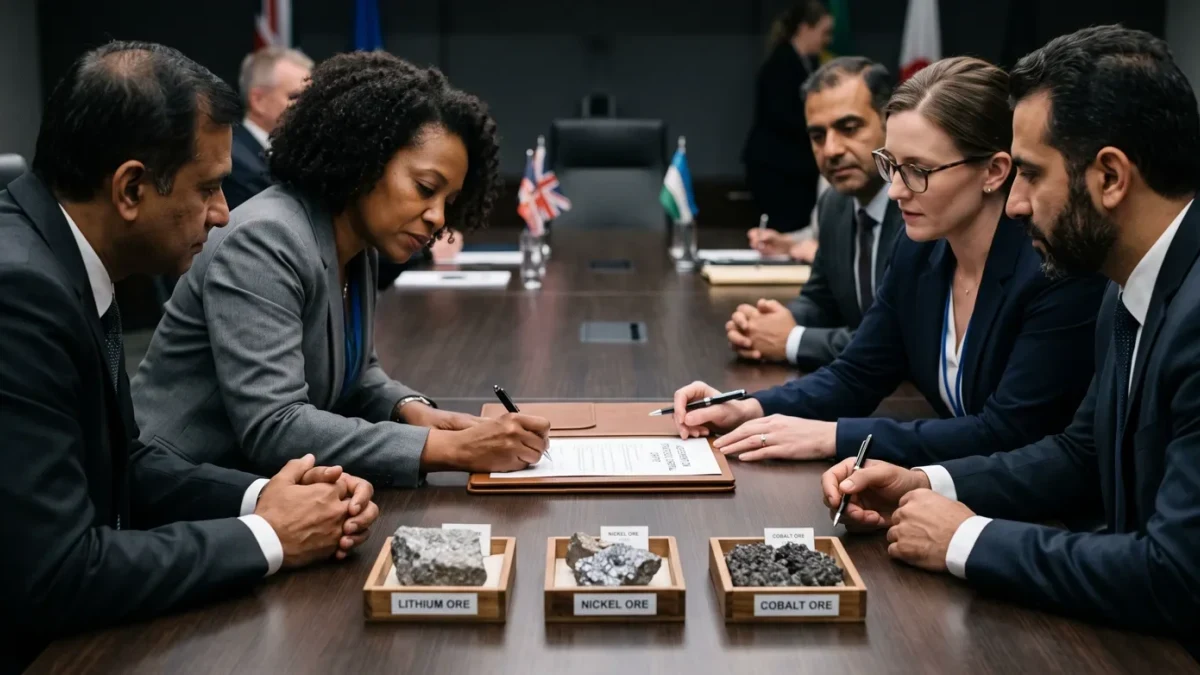
Critical minerals agreements are the narrow trade deals — covering lithium, nickel, cobalt, graphite, rare earths and their processing — through which allied economies build supply blocs. The template case is the U.S.-Japan critical minerals agreement of March 2023: a five-page accord whose operative effect was to make Japanese-sourced critical minerals count as free-trade-partner content under the Inflation Reduction Act's clean-vehicle credit — a trade agreement functioning as an industrial-policy passport. Since then the format multiplied: the U.S.-EU critical minerals talks under the 2023-2025 framework seeking the same IRA treatment; the Minerals Security Partnership — the U.S.-led coalition of 14-plus countries and the EU coordinating project finance across the supply chain; the 2024-2025 U.S.-Ukraine reconstruction and minerals agreement; and Japan and Korea's resource diplomacy across Australia, South America, and Africa. The through-line: minerals, not tariff schedules, now define membership in the allied industrial bloc.
Why minerals agreements instead of free trade deals?
Because comprehensive trade agreements became politically unavailable while industrial subsidy rules demanded partners. The IRA's credit required critical minerals from the United States or a free trade agreement partner — a defined statutory term for which the executive has flexibility — and rather than revive broad FTAs, which Congress has not passed since 2020, administrations negotiated purpose-built minerals accords that satisfy the statute's test: the Japan deal is the precedent, its brevity deliberate, and the EU negotiations — and the political fights over whether an executive agreement without congressional approval qualifies — the follow-on. The result is a new instrument class: mini-lateral, executive-negotiated, subsidy-linked trade deals, faster than treaties, narrower than FTAs, and legally contested at the margins.
What is the Minerals Security Partnership?
The coalition layer: the MSP, relaunched in 2022, unites the United States, the EU, Britain, Japan, Korea, Canada, Australia, Norway, Finland, Sweden, India and others — plus the European Commission — to coordinate government financing and diplomacy for mining, processing, and recycling projects. Its project pipeline — dozens of facilitation efforts across lithium in South America, rare earths in Africa and Europe, graphite and nickel in allied Asia — is the soft-power side of the bloc, offering financing and offtake intermediation to resource countries choosing between Western and Chinese investment terms. The 2024-2025 expansions — the MSP Forum with resource-country participation and the network's agreements with individual producers — formalized what began as a coordination call.
What is at stake for producing countries?
The choice of terms. China's offers — infrastructure-for-minerals packages, state financing, integrated processing — come fast and large; the allied offers come with ESG standards, transparency requirements, slower timelines, and now the minerals-agreement network's market access: IRA credit eligibility, EU strategic-project status under the critical raw materials act, and offtake guarantees. The competition is visible in the cases: Indonesia's nickel — the world's largest reserve — developed with Chinese processing and now facing EU and U.S. scrutiny over both labor and market access; Chile's lithium nationalization-and-partnership model negotiating with both blocs; Kazakhstan and Central Asia's rare-earth commitments to Western consortia in 2024-2025; Ukraine's minerals deal — the war's economic annex, contested in its terms and ratification. Producing countries have learned to auction alignment rather than grant it.
Do these deals work?
For market access arithmetic, immediately: the Japan agreement moved Japanese battery-material suppliers into IRA eligibility on signature — the point of the instrument. For supply transformation, slowly: mines and processing plants take years regardless of agreements' speed, and the visible results so far are financing commitments, offtake frameworks, and permitting priorities rather than new flows at scale — the same timeline problem the rare-earth rebuild faces. For trade law, unresolved: whether executive minerals agreements satisfy statutory free-trade-agreement language is a running interpretive fight; whether the bloc-building they serve violates non-discrimination commitments is a WTO question no one has forced while the appellate system sits paralyzed. The analysis: minerals agreements are the grain of a plurilateral trade order growing inside the WTO's frozen shell — narrow, instrument-linked, and member-checked only by subsidy rules — and they encode a geoeconomic fact: the next decade's trade architecture is being written around inputs to electrification rather than goods at the border; the deals' brevity is misleading, since each one reallocates subsidy access worth billions. What would change the reading is a comprehensive U.S.-EU accord resolving the IRA treatment question — the case that has dragged since 2023 — or a producing-country bloc successfully playing both sides into a genuine third pole, the strategy Indonesia's nickel policy openly pursues.
Frequently asked questions
What is a critical minerals agreement?
A narrow trade deal covering critical minerals supply chains, typically executive-negotiated, whose main effect is eligibility for a partner's industrial subsidies — the U.S.-Japan 2023 agreement made Japanese minerals qualify for IRA clean-vehicle credits.
What is the Minerals Security Partnership?
The U.S.-led coalition of 14-plus allies and the EU coordinating financing and diplomacy for mining and processing projects, building a non-Chinese supply network project by project through financing and offtake facilitation.
Why are minerals deals replacing free trade agreements?
Comprehensive FTAs are politically dead in major capitals, while subsidy rules like the IRA's required free-trade-partner sourcing. Purpose-built minerals accords satisfy those statutes quickly — five pages instead of five thousand — and that is the new template.
Which countries hold the leverage in minerals diplomacy?
Producers with scale: Indonesia in nickel, Chile in lithium, Australia across lithium and rare earths, Kazakhstan and Ukraine in critical deposits. The blocs compete on terms — Chinese speed and integration versus Western financing and market access — and producers increasingly auction their alignment.