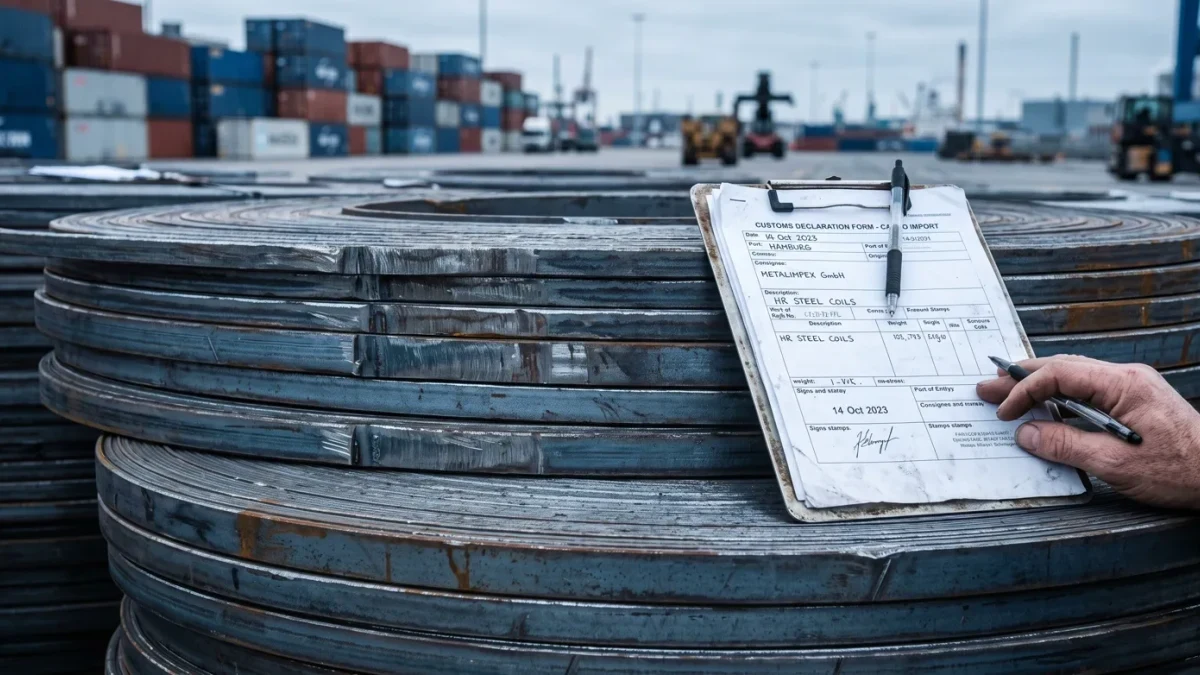
The Carbon Border Adjustment Mechanism is the European Union's tariff on the carbon content of certain imports, designed to equalize carbon costs between EU producers — who pay under the emissions trading system, where allowances traded near 70 to 80 euros a tonne in 2024-2025 — and foreign producers who do not. It entered its transitional phase in October 2023 as a reporting-only regime: importers of cement, iron and steel, aluminum, fertilizers, electricity, and hydrogen filed quarterly emissions reports without paying. The definitive regime begins January 1, 2026: importers must be authorized CBAM declarants, buy CBAM certificates priced off the ETS auction average, and surrender certificates matching embedded emissions — the first year the mechanism carries a real bill, with free allocation for EU producers in covered sectors phasing out in parallel through 2034.
How does the charge work mechanically?
Per imported tonne: embedded emissions — direct plus, from 2026 rules, some indirect — multiplied by the certificate price, which tracks the weekly average ETS auction clearing price, with rebates for carbon prices already paid in the exporting country. The transitional period's own numbers sized the flow: CBAM-covered imports ran about 45 to 50 billion euros a year in value, from thousands of reporting importers — the 2024 reports covering tens of thousands of installations' worth of goods — with iron and steel dominating volume and cement and aluminum behind. The declared-embedded-emissions arithmetic makes CBAM effectively an extension of the ETS to imports — a carbon tariff in all but the treaty-sensitive name, deliberately structured as a border measure on products rather than a duty on goods to stay inside trade-law arguments.
What problems surfaced in transition?
Administrative load: quarterly reports required installation-level emissions data from foreign suppliers — data many could not or would not provide, driving default-value usage above 90 percent in early reporting quarters, a compliance-quality gap the Commission's own reviews flagged before tightening defaults toward punitive values in 2025 to force real data. Coverage politics: the product scope excludes downstream products — some processed steel goods, machined aluminum — a gap the Commission proposed narrowing in its 2025 simplification omnibus alongside de minimis relief for consignments under 50 tonnes. Retaliation and litigation risk: trading partners — China, India, Brazil, South Africa, the United States in 2024-2025 trade talks — have objected as a disguised restriction; the EU's legal defense rests on the GATT's environmental exception, article XX, untested at the WTO for a measure of this design — and the Appellate Body's paralysis means any challenge now ends in a panel report that can be appealed into the void.
What does it mean for exporters to Europe?
Cost and paperwork, unevenly. High-carbon producers face real bills: analysts' estimates for 2026-covered flows run in the low billions of euros annually, concentrated in a few dozen large importers — the oligopoly structure of CBAM declarant registrations — with steel from Turkey, India, and China; aluminum from India, the Gulf, and China; and fertilizers from Russia's remaining flows, now largely banned by sanctions anyway, the exposure map. Exporters can reduce liability by decarbonizing and documenting — the mechanism is explicit about its intent to export the ETS's price signal — and partner-country carbon pricing counts: Turkey's ETS development, India's trading scheme discussions, and the China ETS's expansion all partly trace to CBAM's approach, the policy-diffusion effect Brussels intended. The 2025 U.S.-EU trade talks put CBAM in the tariff-negotiation mix, with American metallurgical exporters seeking exemptions or credit for U.S. programs — unresolved as of the 2026 phase-in.
Does it work as policy?
Two early verdicts. Leakage protection: the design is economically coherent — border charge plus free-allocation phase-out keeps domestic and imported carbon costs equal — but 2026's first year will provide the first real evidence of trade diversion around covered products versus actual emissions accounting. Emissions effect: limited by construction — CBAM covers sectors representing under 10 percent of EU imports and a modest share of global emissions — its leverage is the example: the pricing of embodied carbon at a major market's border, the first at scale. The analysis: CBAM is the EU doing with carbon what it did with regulation generally — setting a standard the world trades against, because market size is the enforcement mechanism — and its 2026 bills convert climate policy into geoeconomics: every negotiating partner now prices the EU's carbon border into its industrial and trade strategy, which is precisely the leverage Brussels calculated. What would change the reading is a successful WTO challenge crippling the measure — currently unenforceable — or a linked U.S. carbon program harmonizing charges, the scenario the 2025 talks floated without concluding.
Frequently asked questions
What is CBAM?
The EU's carbon border adjustment: importers of cement, steel, aluminum, fertilizers, electricity, and hydrogen must buy certificates covering the embedded emissions of their goods, priced off the EU emissions trading system. Reporting ran from October 2023; real charges begin January 1, 2026.
How much will CBAM cost importers?
Certificate liability equals embedded emissions times the ETS-linked price — near 70-80 euros per tonne of CO2 in 2024-2025 — minus carbon prices paid at origin. Estimates for 2026 flows run to low billions of euros annually, concentrated in steel and aluminum.
Which countries are most exposed to CBAM?
Turkey, India, China, and the Gulf for steel and aluminum; Russia's covered flows were largely sanctions-suppressed already; U.S. exporters' exposure centers on steel, with 2025 talks seeking credit for American programs.
Can CBAM be challenged at the WTO?
A case would test it under GATT article XX's environmental exception. Any panel ruling could be appealed into the void given the paralyzed Appellate Body — leaving the dispute political rather than judicial, which suits the EU's calculation.