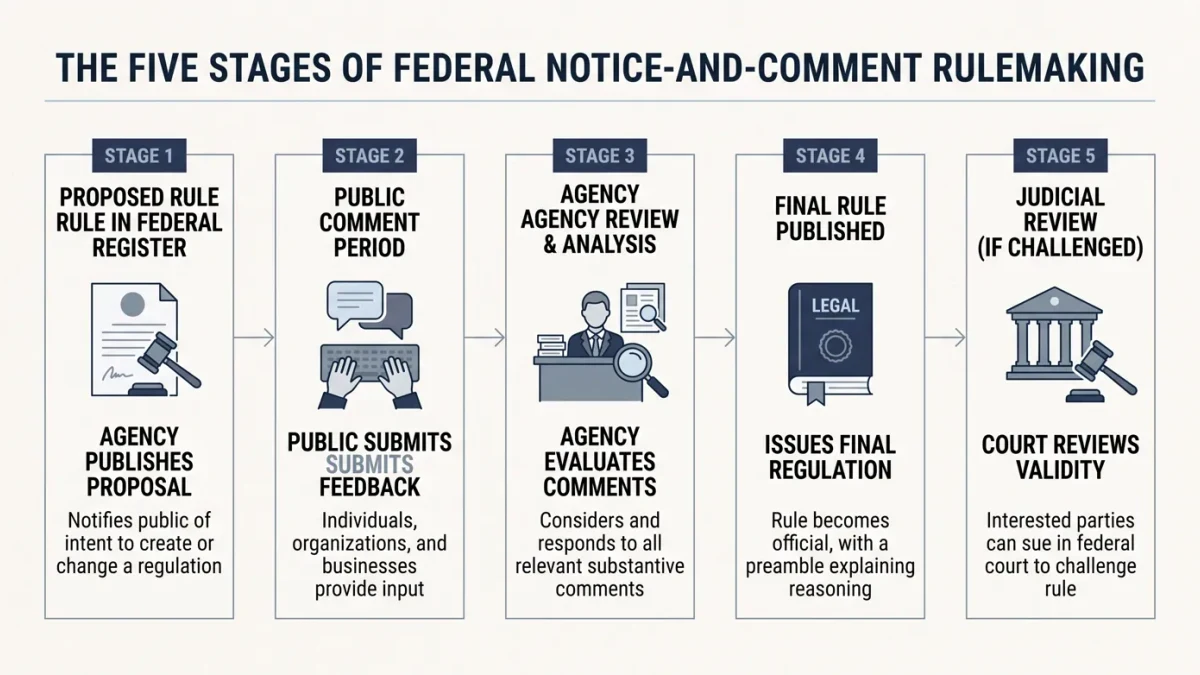
Federal rulemaking is the process by which U.S. agencies turn laws passed by Congress into enforceable regulations, and it follows a fixed sequence set out in the Administrative Procedure Act of 1946: proposed rule, public comment, final rule, and judicial review. In fiscal year 2024, federal agencies finalized 949 significant and non-significant rules tracked by the Government Accountability Office, each one traceable through a public docket. Reliable News publishes information, not legal advice, and this explainer describes the process as the statute structures it.
What starts a rulemaking in the first place?
Three things do: a statute that tells an agency to regulate, an agency's own assessment that a rule is needed, or a petition from outside. Congress regularly sets deadlines — the Dodd-Frank Act of 2010 alone ordered dozens of rulemakings across banking regulators. Agencies must also list what they are working on: the unified agenda of regulatory and deregulatory actions, published twice a year by the Office of Information and Regulatory Affairs, or OIRA, named every planned rule on the docket as of its fall 2024 edition.
What happens at the notice-and-comment stage?
The agency publishes a notice of proposed rulemaking in the Federal Register, which explains the legal basis, the proposed text, and the deadline for comments. The default comment period is 60 days under Executive Order 12866's framework for significant rules, though agencies can shorten or extend it. Comments land in a public docket on regulations.gov — for prominent proposals, tens of thousands of them. The agency must read and respond to significant comments in the preamble of the final rule; courts have overturned rules where the responses were treated as a formality, most prominently in Motor Vehicle Manufacturers Association v. State Farm in 1983, which set the standard that agency reasoning cannot be arbitrary or capricious.
Where does the White House come in?
Before most economically significant proposals and finals leave the building, they pass through OIRA review, which by convention targets 90 days for proposed rules and 45 days for final ones under Executive Order 12866, issued in 1993. OIRA can question the underlying analysis, push for revisions, or return the rule. The review log — what came in, how long it sat, what meetings were held and with whom — is published on reginfo.gov, which makes it one of the few windows into executive-branch deliberation that opens while a rule is still being shaped.
How does an agency show a rule is worth its cost?
Through regulatory impact analysis built on cost-benefit methods set out in OIRA's Circular A-4, first issued in 2003 and revised in 2023. Rules with an annual effect on the economy of 200 million dollars or more must quantify expected benefits and costs over the period the rule is in force. The numbers are estimates, and their assumptions — the value of a statistical life, the social cost of carbon, the discount rate — do more work than the arithmetic itself. The analysis is a disclosure device: it forces the agency to show its reasoning in a format opponents can attack line by line.
When does the rule actually become law?
After the final rule is published in the Federal Register, which sets both its legal text and its effective date — by default at least 30 days later under the APA. The Congressional Review Act adds a second track: Congress can pass a joint resolution of disapproval, which takes down the rule with simple majorities and blocks substantially similar ones from being reissued, and has been used 20 times since 1996, including the 2023 disapprovals of Labor Department ESG investing rules. A rule that survives both becomes enforceable, and the text is eventually codified in the Code of Federal Regulations.
Can the courts still step in?
Yes, and 2024 changed the ground rules. In Loper Bright Enterprises v. Raimondo, decided June 28, 2024, the Supreme Court retired the 1984 Chevron doctrine that told courts to defer to reasonable agency readings of ambiguous statutes. Challenges must be filed in an appellate court with venue within six years of the rule's effective date under the statute of limitations set by the 2024 Corner Post decision, which effectively extended the window for new challengers. The practical effect is that an agency's legal interpretation now has to persuade a judge on its own terms. The analysis: the post-Loper Bright environment shifts interpretive power toward courts, which will likely make pre-adoption legal drafting — and the quality of the statutory delegation Congress writes in the first place — matter more than comment counts. What would change this reading is Congress returning to detailed statutory drafting or a future Court reaffirming deference in some form.
What are the fast lanes and escape hatches?
Direct final rules skip the proposed-rule stage for routine measures and take effect unless an adverse comment arrives. Interim final rules take effect immediately with comment after the fact — the format used for much pandemic-era emergency regulation. Emergency exemptions in APA section 553 excuse notice and comment when an agency for good cause finds them impracticable, unnecessary, or contrary to the public interest, and courts police that finding closely. Each of these lanes trades transparency for speed, and the docket shows which one an agency chose and what justification it gave.
Frequently asked questions
Does commenting on a rule actually change it?
Legally, an agency must respond to significant comments, and poorly reasoned responses are a common basis for courts remanding rules. Comments that supply data, identify errors, or propose alternatives have more force than volume. The response is published in the final rule's preamble.
What is the difference between a law and a regulation?
A law is passed by Congress and signed by the president; a regulation is written by an agency to implement that law. Regulations carry the force of law but can only go as far as the statute allows. Courts test that boundary in challenges to final rules.
How long does the whole process take?
There is no fixed statutory timeline. Routine rules can move in under a year; major rules commonly take two to four years from spring agenda listing to effective date, factoring in OIRA review, comment periods, and litigation risk. The unified agenda lists target dates.
Where can the full text of a rule be found?
The Federal Register publishes proposals and finals daily; regulations.gov hosts the docket, comments, and supporting documents; and the Code of Federal Regulations holds the codified text in force. All three are free and searchable by docket number.