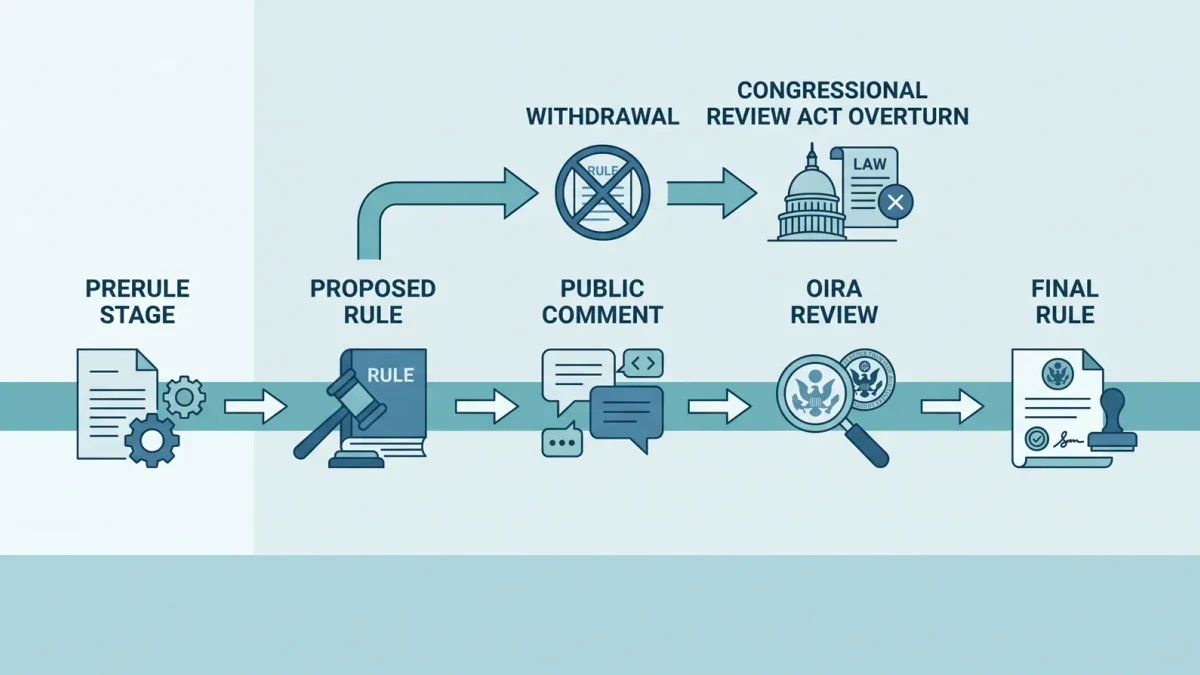
Cost-benefit analysis is the discipline the executive branch imposes on its own rulemaking: before an agency issues an economically significant regulation, it must estimate the rule's total costs and benefits over time and show the benefits justify the costs. The requirement dates to Executive Order 12291 in 1981 and lives today in Executive Order 12866 of 1993, administered by the Office of Information and Regulatory Affairs. The methods manual is OIRA's Circular A-4, first issued in 2003 and comprehensively revised in November 2023 — the first rewrite in twenty years. Reliable News publishes information, not policy advice; this explainer covers how the ledger works.
When is the analysis required?
For regulatory actions deemed significant, and in full for those with an annual effect on the economy of 200 million dollars or more — the economically significant tier that triggers a formal regulatory impact analysis. The agency drafts it, OIRA reviews it during its 90-day window, and the final analysis is published in the rule's docket. In practice the coverage is broad: OIRA's annual reports to Congress reviewed roughly 500 to 700 significant actions per year in the 2020s, with benefits from major rules estimated in the hundreds of billions of dollars, dominated by air-pollution rules whose particulate benefits the EPA's own analyses price largest.
What goes in the ledger?
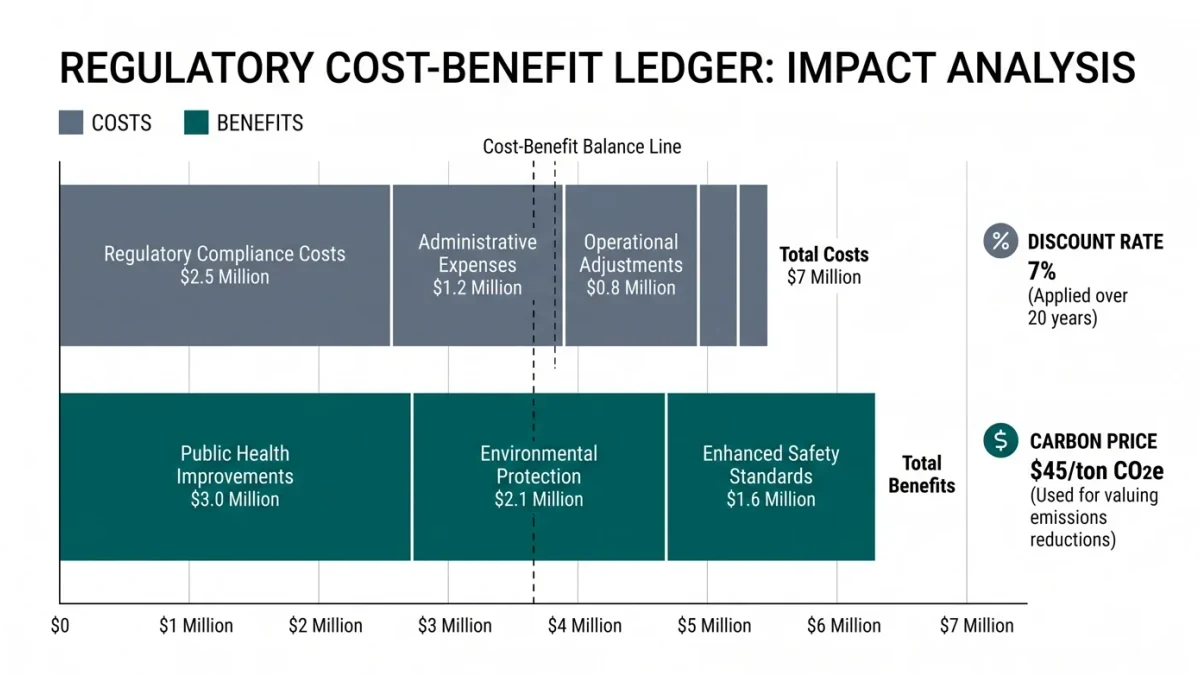
Compliance costs, administrative costs, and transitional costs against counted benefits: reduced mortality and illness, time saved, ecosystem services, and avoided damages. Three parameters do most of the work. The value of a statistical life — around 13.4 million dollars per avoided death in 2026 dollars under current departmental practice — prices mortality benefits. The social cost of carbon — set at about 190 dollars per ton of carbon dioxide under the EPA's 2023 framework — prices climate damages. And the discount rate — brought down to 2 percent in the 2023 A-4 from the old 3 and 7 percent rates — decides how much future lives count against present costs.
What did the 2023 revision change?
Four things at once. It lowered the central discount rate to 2 percent, raising the present value of long-horizon benefits like climate and health. It moved the social cost of carbon to a global damages basis, raising the figure several-fold from the domestic-only approach used from 2017 to 2021. It told agencies to weigh distributional effects — who bears the costs and who gets the benefits — explicitly rather than in footnotes. And it updated the valuation of mortality risk. Taken together the revision raises the stated benefits of health and climate rules substantially, which is why it drew both praise as modernization and litigation as analytically driven deregulation-by-artisan choice; the 2025 executive orders directing agencies to re-adopt earlier frameworks show the manual is now as contested as any rule it scores.
Who checks the math?
OIRA first, in the review that can return a rule for rework. Courts second — since 2024's elimination of Chevron deference, agencies' analytical reasoning must stand on its own, and challengers attack the analysis as arbitrary under the State Farm standard. Academia and the Government Accountability Office third: GAO's periodic reviews of agency regulatory analyses have repeatedly found wide variation in how agencies treat uncertainty and employment effects. The 2023 revision's fate in litigation remains the open variable for every rule issued under it.
What are the honest criticisms?
Three recur. Monetizing life, health, and nature forces dollar precision on values that resist it, and the choice of parameters can swing a rule's net benefits more than the underlying science. Distributional blindness — partially corrected in 2023 — historically let rules pass on averages while costs concentrated on specific workers or regions. And unquantifiable benefits are systematically underweighted, a bias analysts acknowledge: some statutes, like the Clean Air Act's provision against considering costs in setting air-quality standards, deliberately take cost-benefit logic off the table. The analysis: the ledger is best read as a discipline of disclosed reasoning rather than a decision machine — it forces agencies to state assumptions an opponent can attack, which is a real value even when the numbers are soft. What would change the reading is either the 2023 framework or a successor surviving sustained judicial review, which would settle the manual's authority for a generation.
Frequently asked questions
What is a regulatory impact analysis?
The formal cost-benefit study an agency must prepare for economically significant rules — those with 200 million dollars or more in annual effects — following OIRA's Circular A-4 methods. It is published with the rule and is the main target of OIRA review and later litigation.
What is the value of a statistical life?
The willingness-to-pay-based figure agencies use to price small mortality-risk reductions — around 13.4 million dollars per avoided death in 2026-dollar practice. It is not a payment to anyone; it aggregates many small risk reductions across exposed populations.
What is the social cost of carbon?
The estimated present damage of one additional ton of carbon dioxide emissions, about 190 dollars per ton under the EPA's 2023 global-damages framework. It converts climate impacts into dollars for rulemaking ledgers, and its methodology is contested in litigation.
Did the 2023 Circular A-4 rewrite make rules stricter?
It raised counted benefits of health and climate rules by lowering the discount rate to 2 percent and pricing carbon globally. Whether rules became stricter depends on the statute; the change made more rules pass the benefits-justify-costs test as scored.