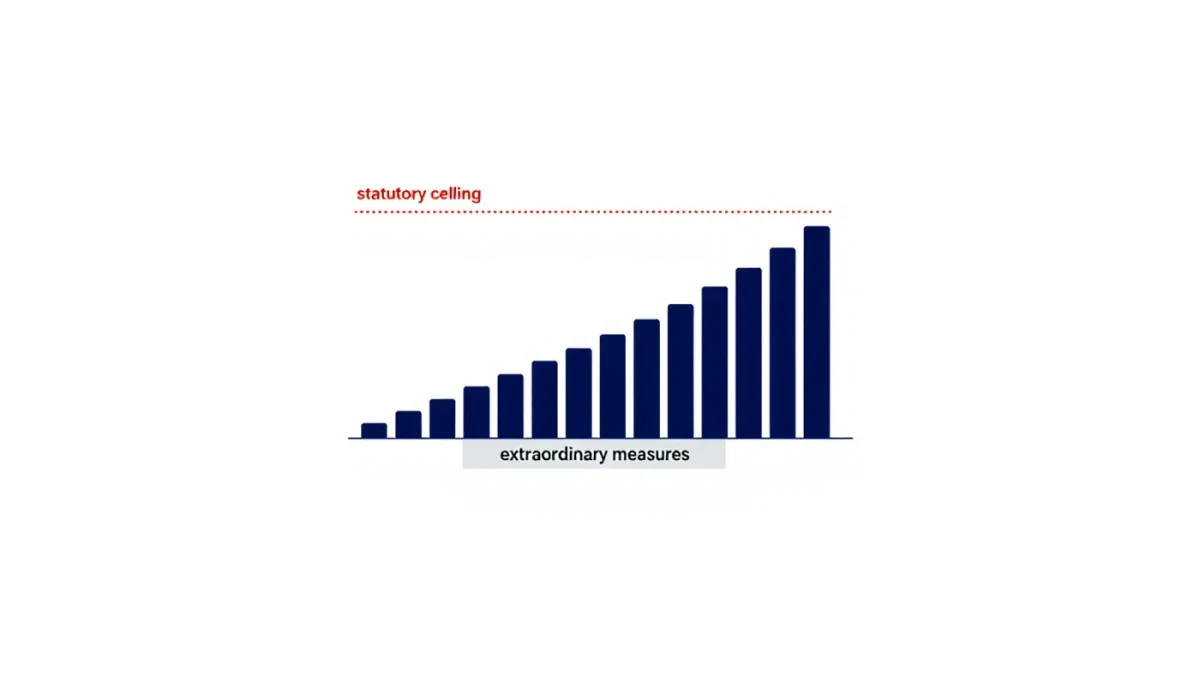
The debt ceiling is a statutory cap on the total face value of debt the Treasury may issue to fund spending Congress has already mandated. Set at 31.4 trillion dollars by a 2021 law and suspended rather than raised since, it next binds whenever the current suspension lapses; the truly binding deadline is the X-date — the day Treasury's cash and extraordinary measures run out — which the Congressional Budget Office and private forecasters estimate rather than announce. Reliable News publishes information, not investment or legal advice, and this explainer covers the mechanism as statute and Treasury practice define it.
Why does the United States cap debt it has already voted to incur?
Before 1917, Congress approved each bond issuance separately. The Second Liberty Bond Act let Treasury aggregate borrowing under one limit, and the modern ceiling dates to 1939 and 1941 statutes. The quirk is structural: the vote to spend and the vote to borrow for that spending are separate, so the ceiling does not authorize anything new — it acknowledges the arithmetic of past decisions. Only the United States and Denmark among developed economies retain a nominal cap of this kind, and Denmark sets it far above outstanding debt precisely to avoid standoffs.
What are extraordinary measures?
Accounting maneuvers that let Treasury keep paying bills after hitting the cap: suspending investments in federal employee retirement funds' G-fund, exchanging securities in the Civil Service and Postal funds, and similar actions, all of which must be made whole afterward. Treasury announces when it starts deploying them — as Secretary Janet Yellen did in letters to Congress in January 2023, the last full standoff before suspensions became the norm again — and publishes daily cash and debt statements so the run-rate toward the X-date is public arithmetic, not insider information.
What actually happens on an X-date?
Treasury's stated position is that it prioritizes nothing by policy choice: it would fail to pay some obligations on time, whether interest, Social Security checks, military pay, or contractor invoices. The 2011 standoff offers the nearest dress rehearsal — Standard & Poor's downgraded U.S. debt to AA-plus on August 5, 2011, citing political brinkmanship, and the rating remains below AAA as of 2025 despite subsequent ceiling deals. That episode is also the record on market impact: short bill yields around risky dates rose while the broader market stress resolved once the Budget Control Act passed.
How have standoffs ended?
Every one has ended with a suspension or increase, sometimes packaged with deficit measures: the 2011 Budget Control Act caps, the 2023 Fiscal Responsibility Act's spending caps and program changes in exchange for a suspension through January 1, 2025, and subsequent clean suspensions. The 2023 act's provisions — caps on discretionary appropriations, clawbacks of unobligated pandemic funds, and work requirements in certain benefit programs — illustrate the standard currency of a deal: process and program changes, not default.
Are there workarounds, and are they serious?
Two are debated and never used. The trillion-dollar coin rests on a 1997 law letting Treasury mint platinum coins in any denomination; depositing one at the Fed would add bookkeeping capacity, but no chair of the Fed or Treasury leadership of either party has endorsed it. The 14th Amendment argument holds that debt-ceiling-induced default would violate the clause providing that public debt shall not be questioned; Presidents Obama and Biden both consulted lawyers and declined to test it in crisis. The analysis: both workarounds trade a payment crisis for a constitutional and market-credibility crisis, which is why they remain law-review fixtures rather than policy. What would change the reading is a court ruling blessing unilateral issuance — none exists.
Who holds the risk?
More than mutual funds and foreign central banks do. Social Security's trust funds, federal retirement funds, and bank treasury portfolios hold Treasury securities; money-market funds hold bills maturing around X-dates and have historically demanded premium yields on them. Foreign holders — Japan and China the largest, at roughly 1.1 trillion and 0.75 trillion dollars respectively per Treasury International Capital data as of 2025 — hold the securities, not the standoff risk, since missed payments would eventually be made whole with interest. The recurring cost is not missed interest; it is the accumulation of small, measurable damage: elevated near-date bill yields, downgrade history, and the drift of payment-system trust.
Frequently asked questions
Does raising the debt ceiling authorize new spending?
No. It lets Treasury borrow to pay for spending Congress already enacted. Raising or suspending the ceiling changes no budget; it prevents default on obligations already legally owed. Debates over new spending happen in appropriations and reconciliation.
What is the X-date exactly?
The first day Treasury's cash plus extraordinary measures cannot cover all obligations due. It depends on tax receipts and refund season, so estimates move; CBO and Treasury statements narrow the window as cash data accumulate. Missing the X-date is what brinkmanship actually risks.
Has the U.S. ever defaulted?
Not on its declared intent to pay regular debt-service, though a 1979 processing episode delayed some bill payments and was litigated. The 2011 standoff triggered the first downgrade of U.S. debt, by S&P, which has kept the rating below AAA since.
Why not just abolish the ceiling?
Many economists and Treasury secretaries of both parties have recommended it, since spending votes already set the debt path. Others value it as leverage for fiscal discipline. Denmark's version, set far above outstanding debt, shows a ceiling can exist without standoffs.