Tariff revenue collection works in three steps. First, U.S. Customs and Border Protection assesses the duty when goods enter the country. Second, the importer pays it, typically within 10 days of the goods clearing customs, according to GovFacts. Third, the money is deposited into the Treasury's general accounts, where it mixes with every other federal receipt.
There is no dedicated tariff jar in the federal budget. Customs duties are not earmarked for a specific program or agency. They enter the same pool as income taxes and payroll taxes, and only an act of Congress directs how the money is spent. That distinction matters for any policy debate that treats tariff revenue as a pot with a label on it. For related coverage, see How Federal Rulemaking Actually Works, Step by Step.
The collection side is more layered than most headlines suggest. A shipment's duty is a stack of separate charges, not one rate, as the US Tariff Tracker 2026 documents: a base rate from the Harmonized Tariff Schedule, plus any trade-remedy duties that apply to the product and its origin, plus fixed user fees.
Who collects the money, and when?
Customs and Border Protection, the border agency inside the Department of Homeland Security, is the collector. When a ship or plane arrives with foreign goods, the importer of record files an entry that states the product's classification, its country of origin, and its declared value. Those three facts determine the duty.
The importer, not the foreign exporter, pays the tax. Per GovFacts, payment is typically due within 10 days of the goods clearing customs. The importer is legally the payer; the economic burden is a separate question, since importers often pass costs to buyers through prices.
Classification is where the money gets decided. A product coded under the wrong 10-digit Harmonized Tariff Schedule line can owe a very different amount. The tracker's own checklist makes the point operationally: confirm the program, confirm the code, confirm the origin, then estimate the landed cost before the shipment moves.
What exactly gets stacked onto a shipment?
The base rate comes first. This is the standard duty in the Harmonized Tariff Schedule, set by law and international agreements. On top of it sit the trade-remedy layers, each authorized under a different statute.
As of 2026, the tracker lists Section 301 duties on China-origin goods ranging from 7.5% to 100%, stacking on the base rate. Section 232 duties on steel, aluminum, and copper were raised to 50% in April 2026 and apply regardless of origin. A separate forced-labor action adds 10% to 12.5% on most products of 60 economies, though goods covered by Section 232 are exempt from it.
Then come the fees. The merchandise processing fee runs 0.3464% of value with fixed minimums and maximums. Ocean shipments also carry a 0.125% harbor maintenance fee. These are small relative to the remedy duties, but they are collected through the same entry process and land in the same accounts.
A worked example from the tracker shows how the stack compounds. Chinese woven apparel with a $10,000 customs value and a 5.5% base rate owes $550 in base duty plus $2,500 under Section 301, for a total of $3,050, or 30.5% of value. The same headline rate on two different products can produce very different bills.
Where does the money go once Customs has it?
After collection, the accounting moves to the Treasury. Duties, fees, and taxes collected at the border are deposited into the federal government's general receipt accounts. From there they are available to fund whatever appropriations Congress enacts — defense, health care, debt interest, everything.
This is the step most commentary skips. A duty paid in Los Angeles does not fund the Port of Los Angeles. The harbor maintenance fee is the closest thing to an earmarked border charge, and even its spending flows through congressional appropriation. Everything else is fungible.
That fungibility has a practical consequence for budget arithmetic. Tariff revenue can substitute for other revenue in the government's overall ledger, which is why it appears in deficit projections. But it cannot be assigned to a cause by anyone other than Congress. The budget reconciliation process is one of the few fast-track routes through which revenue assumptions like these become law.
What happens when a tariff is struck down or expires?
Tariffs are legal instruments, and legal instruments can lapse. The tracker records a recent case: a 10% global surcharge imposed under Section 122 of the Trade Act of 1974 expired on July 24, 2026, at the 150-day statutory maximum, with no extension by Congress. Liability turned on the entry date — goods entered before the cutoff owed the surcharge as filed, goods entered after owed nothing.
That same measure illustrates the litigation risk. The Court of International Trade held the proclamation invalid in May 2026; the Federal Circuit stayed that ruling in June pending appeal. The appeal now bears on refunds of surcharge already collected, not on new entries. Money already in the Treasury can therefore flow back out, if courts order repayment.
For the budget, this cuts both ways. Revenue counted early may have to be returned. Refund liability is a real line in the accounting, and it is one reason customs collections are not simply additive with other revenue.
Who wins and who loses in the collection system?
The winners are straightforward: the Treasury receives the receipts, and protected domestic producers face less import competition. The system also rewards preparation. Importers who classify accurately and document origin pay exactly what the schedule requires, no more.
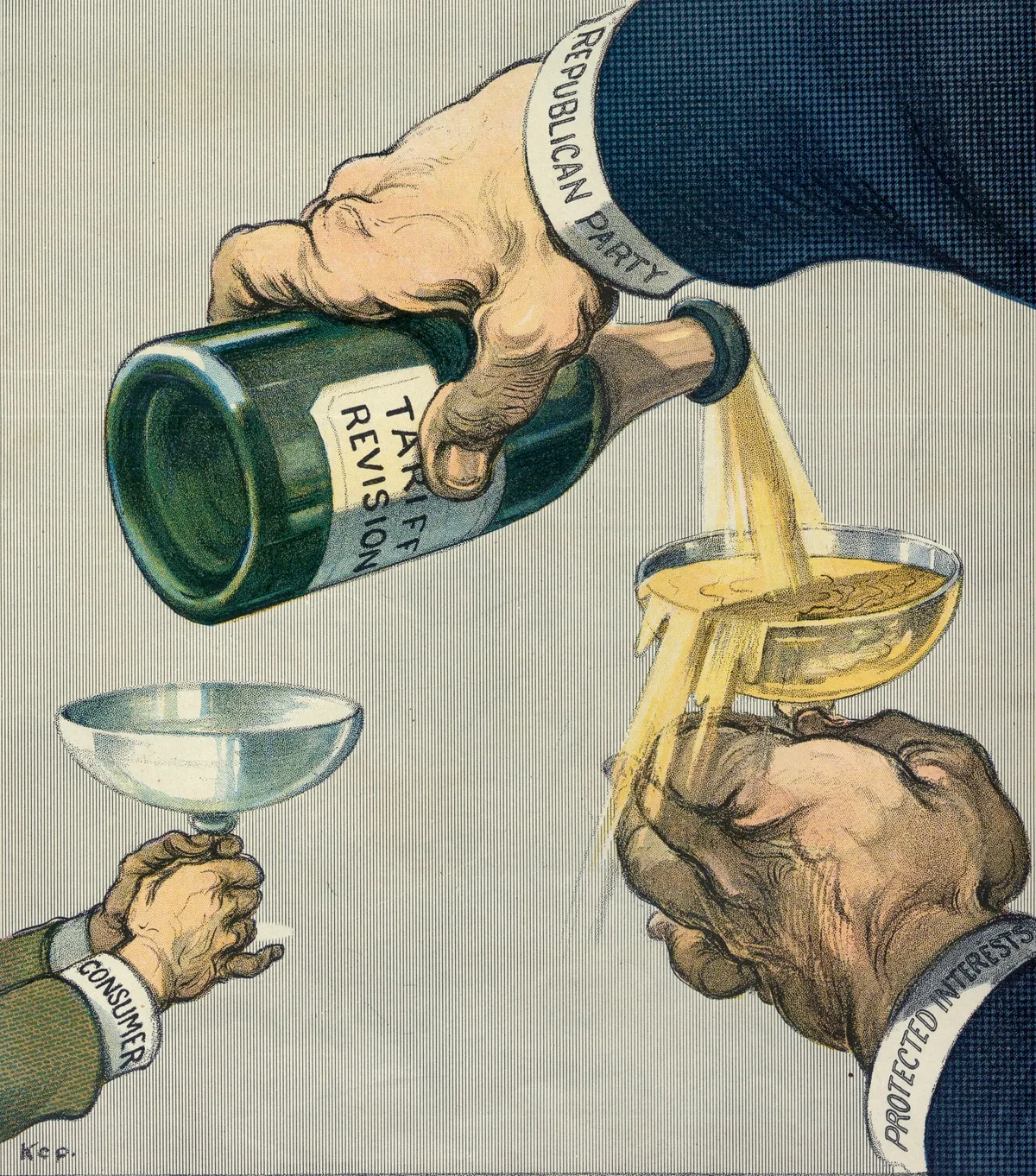
The losers, at least in the first instance, are importers and their customers. GovFacts describes the tariff as an economic wedge between what a foreign seller receives and what an American buyer pays. On a $100 product with a 25% tariff, the buyer's cost rises to $125 while the seller still receives $100. The gap is the tax, and someone in the domestic supply chain absorbs it.
The strongest counter-argument to treating tariffs as a costless revenue source is administrative and behavioral. High rates change what gets imported, which shrinks the base the rates apply to. Exclusions and exemptions carve out more. The revenue estimate that looked solid at announcement rarely survives contact with actual entry data.
The analysis: The sourced record shows a collection system that is mechanically simple — classify, pay, deposit — wrapped around a rate structure that is anything but. The reading: debates about tariff revenue tend to argue about the rates while the budgetary reality lives in the plumbing. What would change this reading is evidence that duties are being diverted to dedicated accounts at scale, which current law does not provide.
What this means for readers following the numbers
Three takeaways hold without any forecast. One: tariff revenue is general revenue. Two: the importer pays, but the burden travels. Three: the stack, not the headline rate, determines what any given shipment owes.
For readers tracking the fiscal side, the same deposit-then-appropriate logic governs other federal money questions, including what happens when the debt ceiling binds. And for the revenue estimates themselves, the Congressional Budget Office's role is the place where tariff assumptions become official numbers. The broader lesson is that a border tax is only as predictable as the classification, origin, and legal foundation underneath it — and all three can change. This connects to our earlier piece, How the Debt Ceiling Works, and What the X-Date Means.