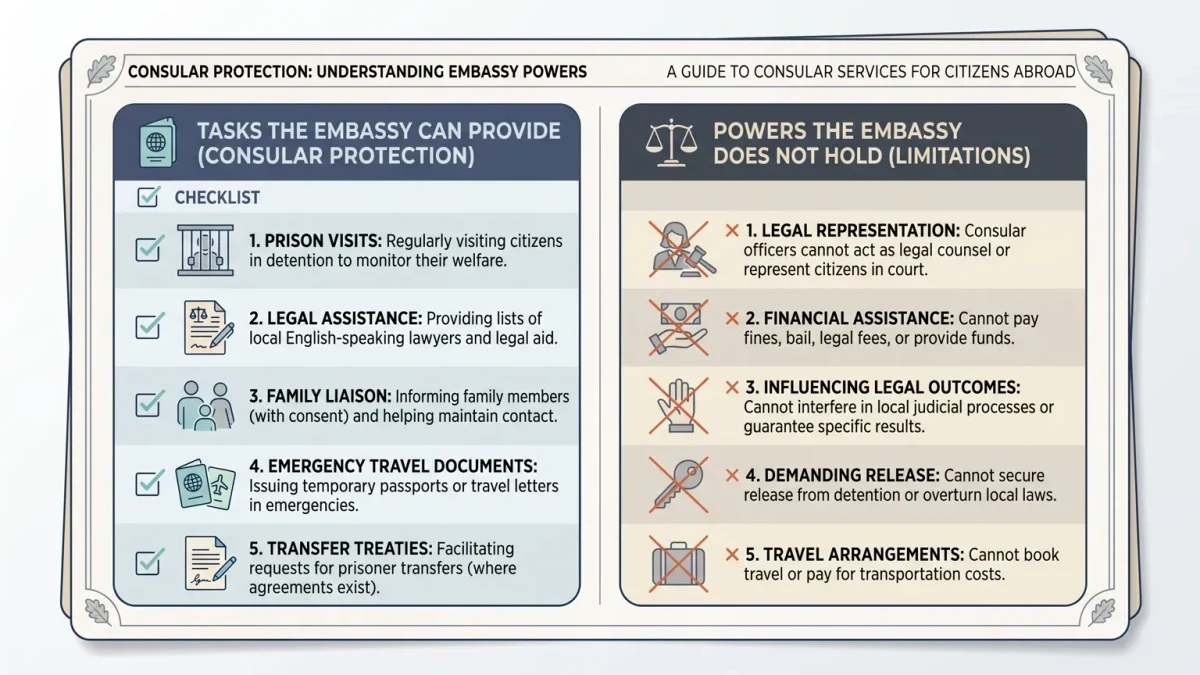
Consular protection is the set of services a state's consular officers may provide to its citizens in trouble abroad: notification when they are detained, access to check on their welfare, lists of local attorneys, and help communicating with family. The framework is the Vienna Convention on Consular Relations of 1963 — ratified by 183 states — whose Article 36 requires local authorities, on request, to inform the consulate of a detained foreign national's arrest and to allow consular access. What it does not provide is intervention in the host state's justice: no immunity, no exemption from local law, no payment of lawyers beyond emergency loans. U.S. consular officers assisted in roughly 9,000 arrests of Americans abroad in a recent typical year, per State Department statistics; the overwhelming majority resolved through local legal processes.
What happens after an arrest abroad?
The sequence is fixed by Article 36. On the detainee's request — or, under many bilateral agreements, automatically — the arresting authority must notify the consulate without delay. The consular officer then requests access, visits, checks welfare, and provides a list of English-speaking or vetted local attorneys compiled by the embassy. The officer cannot attend interrogations, demand the detainee's release, or override local procedure: the State Department's own guidance to citizens says plainly that consular officers cannot get you out of jail. The 2008 Supreme Court decision in Medellín v. Texas held that the convention's notification right binds states but individuals cannot enforce it in U.S. courts absent implementing legislation — the same asymmetry citizens of other countries face in reverse. The consequence is political: notification failures become diplomatic protests, as the World Court's Avena case against the United States and the ICJ's provisional measures in death-penalty cases have repeatedly shown.
What else falls under consular protection?
Medical emergencies — contacting family and insurers, never treatment decisions; victim assistance after crimes, including guidance through local compensation systems; welfare-and-whereabouts checks for out-of-contact citizens; destitute-citizen repatriation loans, repayable with interest under 22 U.S.C. 2671, with passports limited until repayment; and crisis response — the evacuation flights and manifest processing of Kabul 2021 and Sudan 2023 were consular operations at scale. Deaths abroad close the list: consular officers notify next of kin, explain local autopsy and release procedures, and can help shipping remains or ashes home, but they act through families and funeral services, not in place of them.
What are the standing limits?
Dual nationals are the classic trap: under the dominant not-recognized rule in the second state of nationality, the consulate of the other nationality has no Article 36 rights — the country whose nationality the person is using controls access, a recurring problem in Iran and other states that do not recognize U.S. dual nationality. Prisoner transfers offer partial relief: the U.S. program under its treaties, with roughly a dozen active partners, can move sentenced prisoners home to serve time, but only with both states' and the prisoner's consent. And sovereignty is the outer wall: the host's courts decide guilt, and consular presence at trial exists only if the host permits observers.
When does consular protection become international law drama?
When detention meets geopolitics. The ICJ's Avena and LaGrand judgments against the United States for Article 36 failures in capital cases; Russia's detention of Americans the State Department classifies as wrongfully detained, where consular access denials become sanction-list triggers; the 2022 detention of WNBA player Brittney Griner, where consular visits were the one channel that functioned — all run through the same narrow Article 36 machinery, with its slow remedies. The leverage is reputational and reciprocal: states that deny access invite the same treatment for their own citizens, which is why the system holds at all.
How should a traveler actually use it?
Enroll in the State Department's Smart Traveler Enrollment Program before travel, so the nearest post knows to look for you in a crisis; carry the post's emergency number, distinct from the embassy's political line; if detained, ask for consular notification explicitly and in writing; and remember the deliverables are visits, attorney lists, family contact, and loans — not legal defense. The analysis: consular protection is deliberately a thin service layer on top of full local jurisdiction, a design choice from 1963 that trades enforceability for universality — every state accepts it because it demands so little — and wrongfully-detained cases show exactly how thin, with remedies arriving through diplomacy years after sentences. What would change the reading is individual enforceability of Article 36, which the Medellín court refused and no treaty change has supplied.
Frequently asked questions
Can the embassy get me out of jail abroad?
No. Consular officers can visit, notify family, provide attorney lists, and monitor conditions, but they cannot demand release, interfere with local courts, or pay legal fees. Local law runs your case; the consulate watches it.
What is consular notification under Article 36?
The Vienna Convention duty of arresting authorities to inform the relevant consulate of a detained foreign national's arrest on request and allow consular access without delay. Failure is a treaty violation pursued diplomatically — the basis of the ICJ cases against the United States.
Will the government pay to fly me home if I'm stranded?
Possibly, as a loan: destitute-citizen repatriation loans cover the ticket and are repaid with interest, with passport validity limited until repayment. Grants are not available; loans are the sole mechanism.
Does consular protection work for dual citizens?
Only in the state where the other nationality is not held. Countries like Iran that reject dual nationality treat a citizen as solely their own, blocking the second consulate's access — the standing hazard for dual nationals traveling to their other country of nationality.