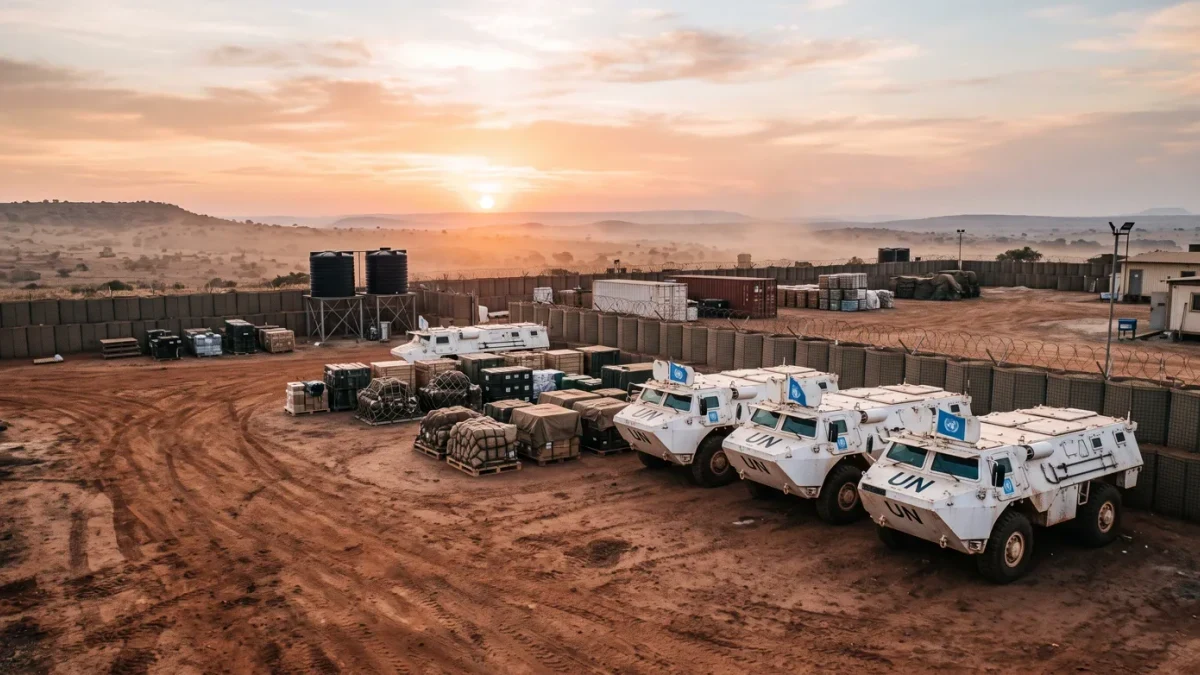
UN peacekeeping is the system of multilateral military and police deployments run by the Department of Peace Operations under Security Council mandates. As of 2025, 11 active missions deploy roughly 61,000 personnel at an approved budget of about 5.6 billion dollars for the year from July 2024 to June 2025, per UN budget documents — under 0.3 percent of global military spending. Two mechanisms define it: mandates written by the Security Council and renewed on fixed cycles, and budgets set by the General Assembly on a scale of assessments that tracks each state's share of world income. This explainer covers the machine.
What is in a mandate?
The Council resolution that creates a mission: its tasks, strength ceiling, rules of engagement, and reporting duties. Mandates distinguish Chapter VI consent-based observation from Chapter VII enforcement authority — the line between monitoring a ceasefire and protecting civilians by force, as the Mali and Congo missions' robust mandates illustrate. Since the 2000 Brahimi Report and the 2015 High-Level Panel, mandates have accumulated standardized language — protection of civilians, women-peace-and-security benchmarks, human-rights due diligence, strategic reviews — and each mandate is deliberately temporary: most renew every 6 or 12 months, with the 2020s drawdowns in Mali, Sudan, and the DRC's force adjustments showing how renewal votes become exit negotiations.
Who supplies the troops?
Volunteer member states, paid: the UN reimburses contributing countries about 1,428 dollars per soldier per month, a rate raised in 2014 and reviewed since. The top contributors are Bangladesh, India, Nepal, Ethiopia, and Rwanda, which together supply roughly a third of all uniformed personnel — regional powers neighboring the conflicts dominate each theater. The permanent five contribute almost no infantry; their presence is money, aircraft, and mandate politics. Deaths tell the cost distribution: more than 4,300 peacekeepers killed since 1948, with 2023-2024 among the deadliest years for mission personnel in Mali and the Congo per UN casualty reporting.
How does the money flow?
The General Assembly's Fifth Committee approves each mission's budget against the scale of assessments recalculated every three years: the United States is assessed at 27 percent of the peacekeeping budget — capped by Congress at 25 percent in practice, a gap that builds arrears — China about 18 to 19 percent after its scale rise in the 2010s, Japan around 8, and the rest scaled down to minimum rates. Payments lag: peacekeeping arrears stood above 1.7 billion dollars in 2024, with the United States accounting for the largest share, per the UN's own arrears tables. The practical effect lands on troop contributors — reimbursement delays squeeze the armies of poorer states, an issue the Secretariat has flagged to the assembly repeatedly.
What are the doctrine's known failures?
The system's report card has three headings. Consent collapse: host-state expulsion, as Mali ordered MINUSMA out in 2023 and Sudan did to UNAMID's closure process. Atrocity failure under robust mandates — Rwanda 1994 and Srebrenica 1995 remain the permanent case studies, both the subject of UN self-inquiries that changed doctrine toward protection-first. And abuse by peacekeepers: the 2015-2016 peacekeeping scandal cycles in Haiti and the Central African Republic led to the secretary-general's 2017 rights-up-front reporting policy, with paternity claims and exploitation cases tracked publicly since. None of these ended the system; all of them shaped the 2023 New Agenda for Peace's caution about new enforcement mandates.
Why keep it?
Because the alternative is not a better force but none: where the Council can agree, blue helmets monitor borders, run transitional administrations, and hold election security at a per-mission cost a coalition of the willing would not underwrite — the 2018 GAO review of an African Union mission found UN missions dramatically cheaper than a hypothetical U.S. operation. The analysis: peacekeeping is a bargain the Council's politics can price but rarely replace, and its structural risks — arrears from the biggest payer, host consent withdrawal, mandate inflation — are all consequences of the veto design, not separate pathologies. What would change the reading is a sustained payment of arrears by the United States alongside a new scale compromise, which would reverse the funding stress without touching doctrine.
Frequently asked questions
Who decides when peacekeepers deploy?
The Security Council, by resolution setting the mandate, force ceiling, and tasks under Chapter VI or VII. The General Assembly funds what the Council mandates, and the secretary-general manages deployment through the Department of Peace Operations.
How is peacekeeping funded?
Through mandatory assessments on all member states under a General Assembly scale: the United States at 27 percent on paper, capped at 25 by Congress, China near 19, others scaled by income to minimums. Arrears exceeded 1.7 billion dollars in 2024, delaying reimbursements to troop contributors.
Which countries send the most peacekeepers?
Bangladesh, India, Nepal, Ethiopia, and Rwanda lead, supplying roughly a third of uniformed personnel. They are paid about 1,428 dollars per soldier per month; the permanent five contribute mainly funding and aircraft rather than infantry.
Can a country expel a UN mission?
Yes — peacekeeping rests on host-state consent. Mali forced MINUSMA's withdrawal in 2023, and Sudan has pushed mission drawdowns. Exit usually takes months of negotiation over timing and asset transfer.