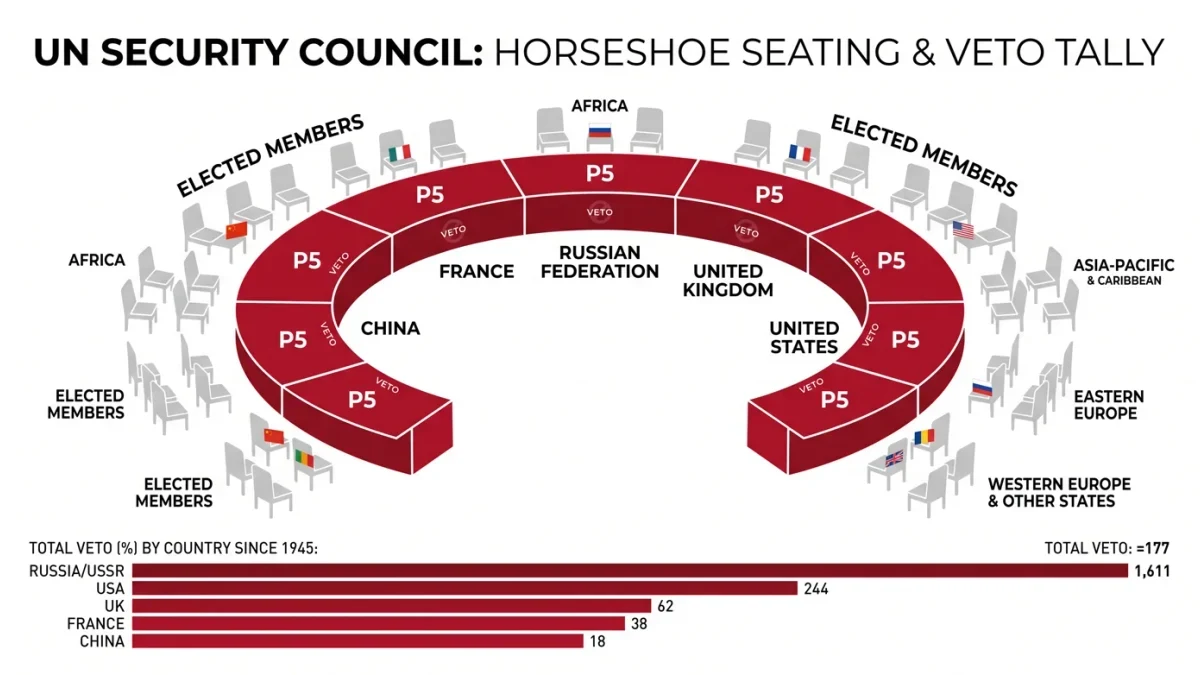
The veto is the permanent members' power, under the UN Charter's Article 27, to block any non-procedural Security Council resolution regardless of support from the other fourteen members. The five permanent members — Britain, China, France, Russia, and the United States — have used it about 293 times since 1945, with the Soviet Union and Russia accounting for the largest share, roughly 120 vetoes as of 2024, per the Security Council's own voting records. The design was the price of great-power membership in 1945: no enforcement system would survive a permanent member voting to sanction its own interests. This explainer sets out how the veto operates and what the system has built around it.
What exactly does the veto cover?
Any substantive matter: resolutions authorizing sanctions, peacekeeping mandates, force, membership recommendations, and secretary-general appointments. Only procedural questions are immune, and the threshold for a substantive resolution is nine of fifteen votes with no permanent-member negative — abstention is not a veto, a convention established in practice since 1946 and applied to the Korea-era resolutions the Soviet Union later contested. The double-veto — two permanent members jointly declaring a question procedural to shield it — was the Cold War's signature maneuver and is now rare.
Who has used it most, and for what?
Russia and its Soviet predecessor lead the count, historically on membership and Middle East questions, and since 2011 on Syria and, after February 2022, on everything touching Ukraine — including the February 25, 2022 draft deploring the invasion, which Russia vetoed while China abstained. The United States has vetoed roughly 85 times, about half concerning Israel, including repeated vetoes of Gaza ceasefire resolutions from October 2023 through 2024, before abstaining on the March 25, 2024 resolution demanding a ceasefire that finally passed. Britain and France have not vetoed since 1989. China's use was sparse until the 1990s and has grown alongside its Syria and Venezuela alignment with Russia.
What can circumvent it?
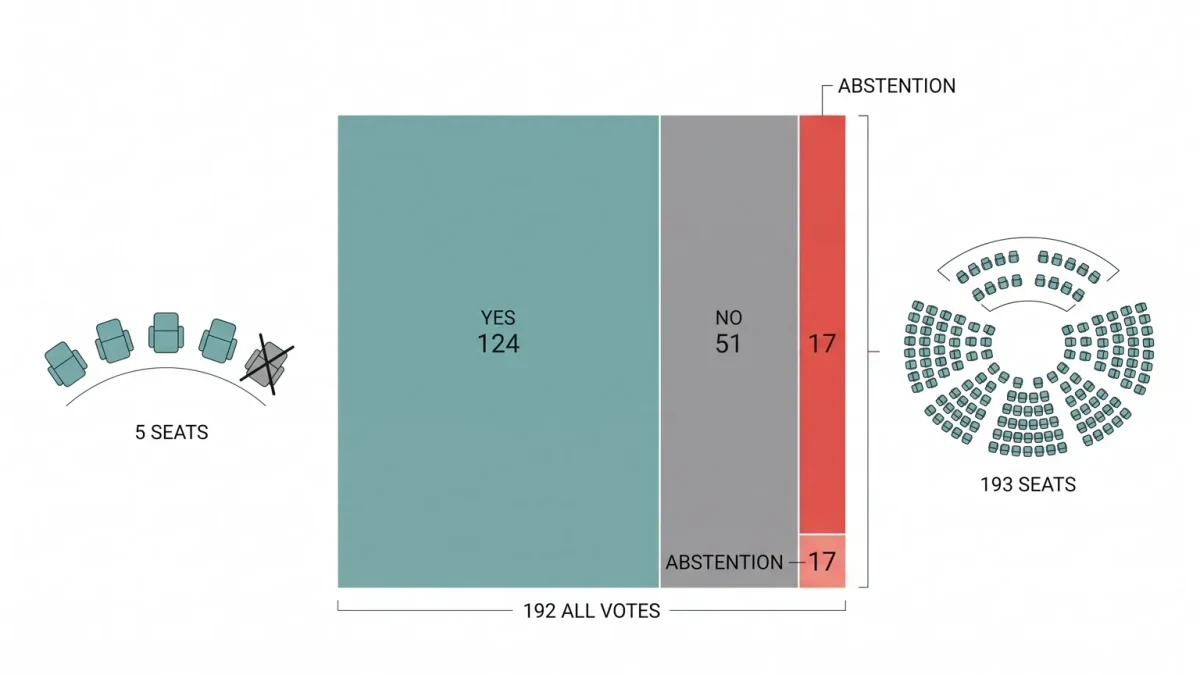
Three routes. The Uniting for Peace procedure, begun in 1950, lets the General Assembly act when the Council is deadlocked: the 2022 emergency special session it triggered produced the resolution deploring Russia's invasion by 141 votes to 5. It recommends but cannot enforce — assembly resolutions are not binding in the Charter's sense. Second, Article 51 self-defense and regional arrangements under Chapter VIII let states and organizations like NATO act outside Council authorization, the Kosovo precedent in outline. Third, the 2022 French-Mexican initiative pledging voluntary veto restraint on mass-atrocity situations, signed by over 100 states, and the 2022 General Assembly resolution requiring the assembly to convene automatically after any veto — the act-now mechanism that has convened the assembly after each Ukraine and Gaza veto since.
Has reform ever come close?
The 1963 amendment adding four elected members came closest to changing composition — the only Charter amendment touching membership ever ratified. Since then, every proposal has collided with the amendment rule: Charter change needs two-thirds of the assembly including all five permanent members' ratifications, meaning any state that loses its veto over reform can veto the reform. The G4 bid — Brazil, Germany, India, Japan — the African Union's Ezulwini positions, and the Uniting for Consensus counter-bloc have been debating in the Intergovernmental Negotiations process since 2009 without a single votable text. U.S. support for permanent seats for Japan and India, stated in 2024-2025 by successive administrations, changes the politics not the amendment math.
What does the veto cost the system?
Legitimacy and responsiveness. The record — Rwanda in 1994, Syria from 2011, Ukraine from 2022, Gaza from 2023 — is the case file for critics who argue the Council enforces against the weak and stalls against the strong. Defenders answer with the counterfactual: a Council without the veto in 1945 likely means no Council, or a walkout at the first Cuba- or Berlin-style crisis, and the machine still delivers real mandates — the 2024-2025 renewal cycles for peacekeeping, the sanctions committees that keep ticking regardless. The analysis: the veto is not a bug the Charter tolerates but the load-bearing wall of the 1945 settlement, and every workaround — Uniting for Peace, the act-now assembly rule, regional action — is a load the drafters deliberately routed around the wall rather than through it. What would change the reading is a permanent member being suspended or a Charter amendment clearing the two-thirds-plus-P5 threshold, neither of which has any precedent.
Frequently asked questions
Which countries hold a veto at the UN Security Council?
The five permanent members: China, France, Russia, the United Kingdom, and the United States. Ten additional members serve two-year elected terms without veto power, meaning resolutions need nine of fifteen votes with no permanent member voting against.
Does abstention count as a veto?
No. A permanent member that abstains or is absent does not block a resolution — settled practice since 1946 and used deliberately, as when the U.S. abstained on the March 2024 Gaza ceasefire resolution.
Can the General Assembly override a veto?
Not override — recommend. Under the Uniting for Peace framework and the 2022 act-now rule, the assembly meets and can vote overwhelmingly, as 141 states did against Russia's invasion, but its resolutions carry political rather than binding enforcement force.
How many times has the veto been used?
About 293 times through 2024, per Council records: roughly 120 by the Soviet Union and Russia, about 85 by the United States, the rest split among Britain, France, and China, with Britain and France silent since 1989.