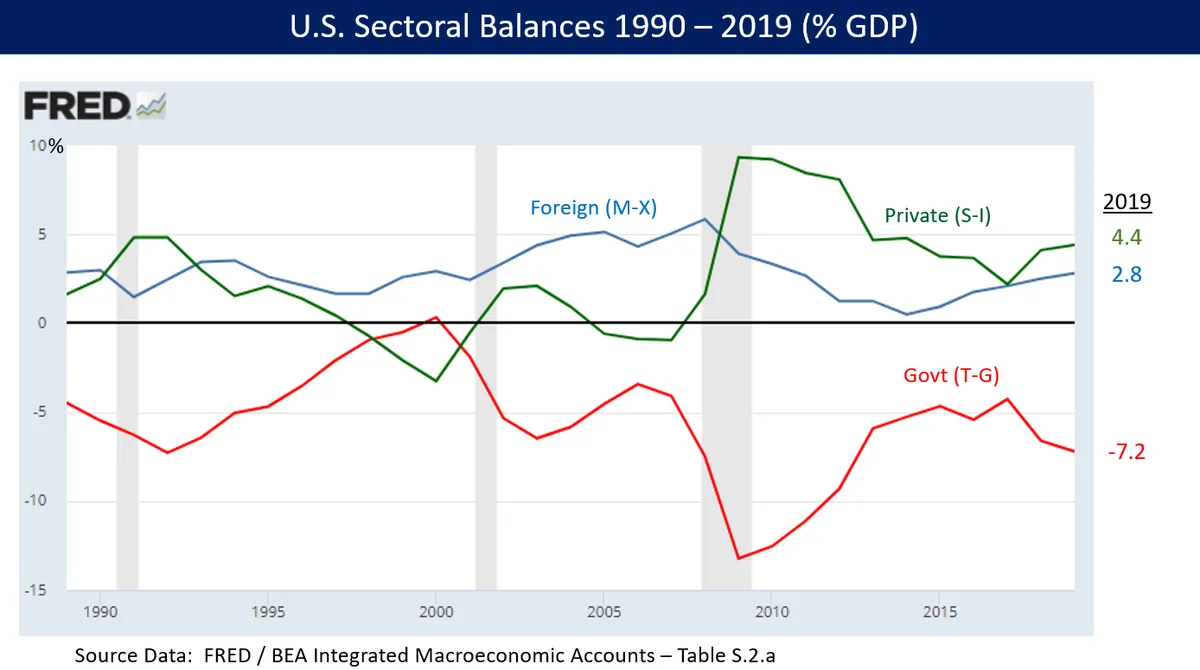
A trade deficit means a country buys more from the rest of the world than it sells to it. That gap is a flow of money leaving the country, and money that leaves has to come back as an investment, a loan, or a sale of assets. This is the trade deficit impact in its simplest form: the current account and the capital account are two sides of one ledger.
The mechanism matters to readers far from any negotiating table. It shapes the exchange rate a tourist pays, the yield on a government bond, and the price of a factory built abroad. Trade, in the basic sense of swapping things of value, has organized economies for millennia; Wikipedia's overview of trade traces exchange from prehistoric gift economies to the specialization and comparative advantage that still explain why regions trade at all. The modern question is what happens when that exchange is persistently one-sided.
What exactly is a trade deficit?
A trade deficit is the gap between what a country imports and what it exports over a period, usually measured in goods, sometimes in goods and services together. It is a flow, not a debt. A country can run a deficit for decades without anyone calling in a loan, because the offset happens automatically in the balance of payments. For related coverage, see How Extradition Between Countries Actually Works.
Every cross-border transaction has two entries. When an importer pays a foreign supplier, the money leaves through the current account and returns through the capital account: someone buys the country's currency, its bonds, its companies, or its property. Economists call this pairing the current account and the capital account. They must sum to zero, up to measurement error, because every payment has a payer and a payee. We covered a connected angle in The 90-Day Clock Behind US Foreign Deal Reviews.
This is why a deficit is best read as a description, not a verdict. It says a country consumes or invests more than it produces, and that foreigners are financing the difference. Whether that is a strength or a vulnerability depends on what the borrowed capital builds.
How does a deficit put pressure on a currency?
The textbook pressure runs through demand for currencies. Importers sell their own currency to buy foreign currency. Exporters do the reverse. If imports exceed exports, more of the home currency is offered for sale than foreigners demand, and the exchange rate tends to soften until other buyers step in.
In practice, that pressure rarely acts alone. Interest rate gaps, inflation expectations, and risk sentiment usually dominate day to day. A country with a deficit, strong growth, and high interest rates can see its currency appreciate, because capital inflows overwhelm the trade flow. A country with a surplus and weak investment demand can see its currency weaken anyway. The deficit is one force among several, not a thermostat.
There is also a self-correcting channel, in principle. A weaker currency makes imports dearer and exports cheaper, which should narrow the gap over time. Economists debate how fast and how reliably this works, because contracts are fixed, supply chains are slow to move, and pricing decisions respond to more than exchange rates. The adjustment is real but gradual and uneven.
Where does the money actually go?
The offsetting inflows take a few recognizable forms. Each has different consequences for the country running the deficit.
- Bond purchases. Foreign buyers of government debt finance the deficit directly and hold the country's borrowing costs down while they stay.
- Foreign direct investment. A company builds or buys a business, bringing durable capital and management. This is the most stable form of inflow.
- Portfolio flows. Purchases of shares and bonds that can leave as fast as they arrived, which makes them the volatile part.
- Asset sales and property. Sales of existing assets, which finance consumption today at the cost of future income streams.
The mix matters more than the total. A deficit financed by long-horizon direct investment reads very differently from one financed by short-term portfolio money that can reverse in a bad week. The composition, not the headline number, is where analysts look first.
Why should bond investors care?
Persistent deficits raise a specific question for bondholders: who will keep financing the gap, and at what price? A country that reliably attracts foreign savings can run deficits for years with stable borrowing costs. A country whose inflows depend on short-term sentiment faces a sharper risk: if the inflows stop, the currency falls and inflation rises, and bondholders demand higher yields to stay.
This is the practical link between the trade account and the bond market. Deficits do not mechanically raise yields. They raise the stakes of any event that shakes investor confidence, because the country needs continuous foreign participation to fund itself. The analysis: a large, persistent deficit is less a predictor of crisis than a measure of dependence. What would change that reading is a shift in the composition of inflows toward stable, long-term investment, or a credible move toward domestic savings.
Bilateral versus multilateral deficits
A country's overall deficit is the sum of many bilateral positions, and the bilateral numbers can mislead. One country may buy more from a second while selling more to a third. The aggregate is what feeds the currency and capital flows described above; the bilateral pairs reflect specialization patterns that trade theory has explained since David Ricardo's comparative advantage, the idea that regions gain by concentrating on what they produce relatively efficiently, a mechanism the standard reference account of trade places at the center of why exchange between regions benefits both.
Policy aimed at a single bilateral gap often just reroutes trade rather than shrinking the total. Supply chains are layered: components cross borders several times before a finished good ships. That is why aggregate balances, not country-pair balances, are the numbers that connect to exchange rates and investment flows.
What this means for readers and investors
Three practical readings follow from the mechanics. First, watch the financing mix, not just the deficit size: stable inflows make a deficit manageable, volatile ones make it fragile. Second, treat the currency as the pressure valve. A softening currency alongside a widening deficit is the adjustment mechanism working, not necessarily a warning. Third, remember the direction of causation runs both ways: strong domestic investment demand can pull in foreign capital and widen a deficit at the same time, which is a sign of appetite, not weakness.
The analysis: the evidence of basic balance-of-payments accounting supports a modest conclusion. Deficits describe how a country relates to world savings. They become a problem when financing turns short-term and confidence-dependent, and a non-problem when they reflect profitable investment funded on durable terms. What would change that reading is a sustained shift in either the composition or the cost of the inflows.
None of this predicts a currency move or a yield. It identifies which numbers to watch, and why the trade account, the exchange rate, and the capital account should always be read together rather than one at a time.