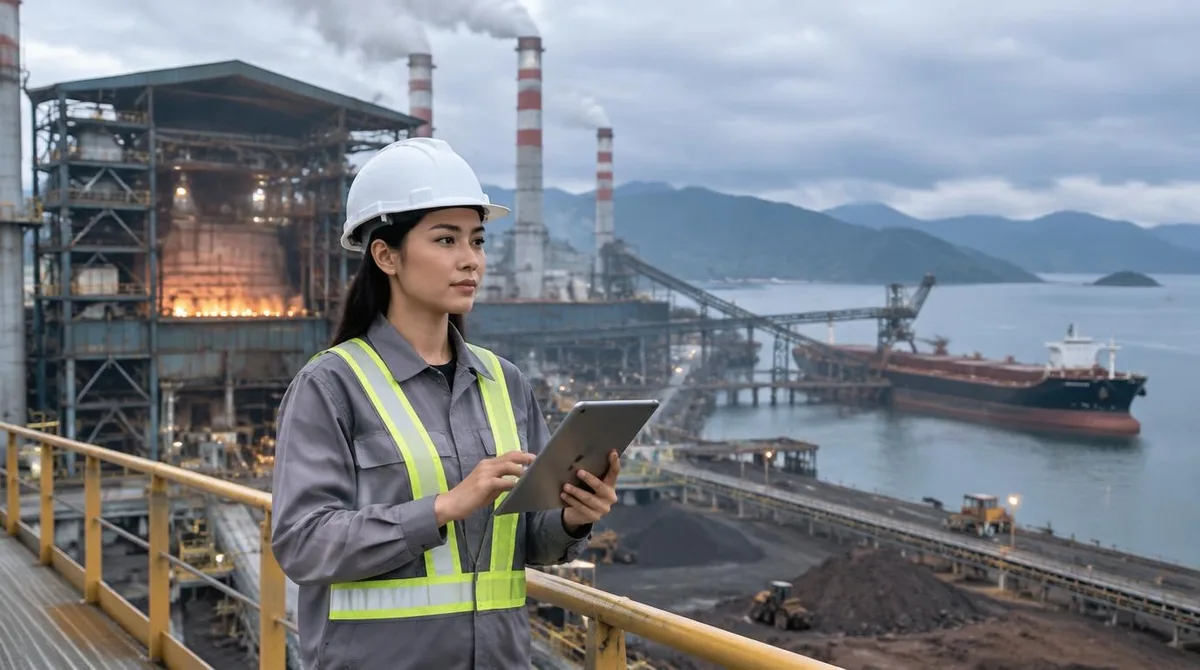
China remains one of Indonesia's largest foreign investors, with realised investment of about US$8.1 billion in 2024 and US$7.5 billion in 2025, according to Indonesia's Ministry of Investment and Downstreaming/BKPM, as reported in a Eurasia Review analysis of the economic relationship. The more important fact is not the size but the direction: the money is shifting out of trade and simple manufacturing and into minerals, base metals, batteries, electric vehicles and industrial estates.
That shift tells a story about where global production is heading. As tariff wars and supply-chain diversification push companies to find production sites with resources, large markets and regional access, Indonesia sits in a position that is hard to ignore. The popular assumption is that this is a one-way resource grab. The investment record points to something more mutual — and more fragile.
How big is the Chinese investment, and where does it go?
In 2024, China ranked third among foreign investors in Indonesia, behind Singapore with US$20.1 billion and Hong Kong with US$8.2 billion, per BKPM data cited in the analysis. The longer arc is larger still: BKPM reported US$32.2 billion in Chinese investment from 2019 through the first half of 2024. Values fluctuate, but the position has held.
The sector mix explains why the relationship matters. Indonesia's five largest investment sectors overall in 2024 were basic metal and metal goods, transportation-warehousing-telecommunications, mining, housing and industrial estates, and other services. The basic metal industry alone reached roughly Rp238.4 trillion. Chinese capital has concentrated in exactly this space — nickel processing, the electric vehicle ecosystem and industrial parks such as the Indonesia Morowali Industrial Park (IMIP), which the analysis describes as one of Indonesia's important centres for mineral processing and metal industries.
Why does China need Indonesia?
The analysis applies John Dunning's eclectic paradigm, a framework in which foreign direct investment happens when a company's own advantages meet a location's advantages. China brings ownership advantages: capital, manufacturing technology, industrialisation experience and global corporate networks. Indonesia offers location advantages: mineral resources, a domestic market of around 280 million people, labour, geography and access to ASEAN.
Two of Indonesia's advantages stand out in the current environment. First, nickel and other critical minerals feed the industries China is building — batteries and electric vehicles above all. Second, Indonesia's position in ASEAN and the RCEP trade network gives Chinese firms access to regional markets far broader than Indonesia alone. The analysis frames Indonesia as a potential regional production base, consumer market and Indo-Pacific supply-chain hub, not merely a place to assemble goods.
Readers tracking how trade rules shape these flows will find related mechanics in our geoeconomics coverage, including how tariff instruments and trade blocs redirect investment.
Why does Indonesia need China?
Indonesia's industrialisation agenda requires what China holds: capital, technology, manufacturing capacity, supplier networks, infrastructure experience and access to global markets. The relationship is therefore more than an investor and a recipient. Each side supplies what the other lacks — Indonesia's resources and market against China's processing and manufacturing capability.
This is the logic of mutual interdependence. But the analysis is careful to note that interdependence does not always mean balance, and that is where the policy question lives.
What is the risk for Indonesia?
The analysis invokes dependency theory: developing countries can become trapped if they supply raw materials, cheap labour and markets while technology, financing, design and strategic decisions stay with foreign companies. On that reading, the danger for Indonesia is not too much Chinese investment but the wrong shape of it — a flow that deepens the country's role as a raw-material and market destination. For related coverage, see Small Business Cash Flow: The Metric That Kills Good Companies.
The counter-strategy the analysis sets out is conversion: turning resource-based investment into domestic capabilities through local supplier development, skills training, research and development, and higher-value production. Whether that conversion happens is the test that will decide whether the relationship builds Indonesian industry or simply relocates Chinese processing offshore.
The analysis: The sourced record shows sustained, sector-shifting Chinese investment — US$8.1 billion in 2024, US$7.5 billion in 2025, concentrated in metals, minerals and industrial estates — against a backdrop of tariff pressure and supply-chain fragmentation. The reasonable reading is that Indonesia's importance to China is rising precisely because fragmentation raises the value of secure resources and regional market access. What would change this reading: a sustained fall in realised Chinese investment, or evidence that the shift into processing is stalling, would suggest the strategic logic is weakening. The record supplied does not yet show either.
What should readers watch next?
Three things carry the story. First, whether BKPM's realised-investment figures keep holding near recent levels, and in which sectors. Second, whether Indonesian policy succeeds in building local suppliers and skills around the processing hubs, which is where dependency risk is decided. Third, how tariff and trade-network dynamics — including RCEP access — continue to shape where multinational production lands. For a wider view of how company-level decisions read as economic signals, see our business news section, and our piece on how supply chain disclosure rules reach U.S. importers for the compliance side of the same fragmentation.