The United States measures consumer inflation two ways. The Consumer Price Index, produced monthly by the Bureau of Labor Statistics since 1919, tracks the cost of a fixed basket of goods and services. The Personal Consumption Expenditures price index, produced by the Bureau of Economic Analysis since the 1990s as part of the national accounts, tracks what households actually spend across a broader universe. In 2024, headline CPI inflation ran at about 2.9 percent year over year in December while the Fed's preferred core PCE measure closed the year near 2.8 percent — a persistent gap that is structural, not statistical noise.
How is the CPI built?
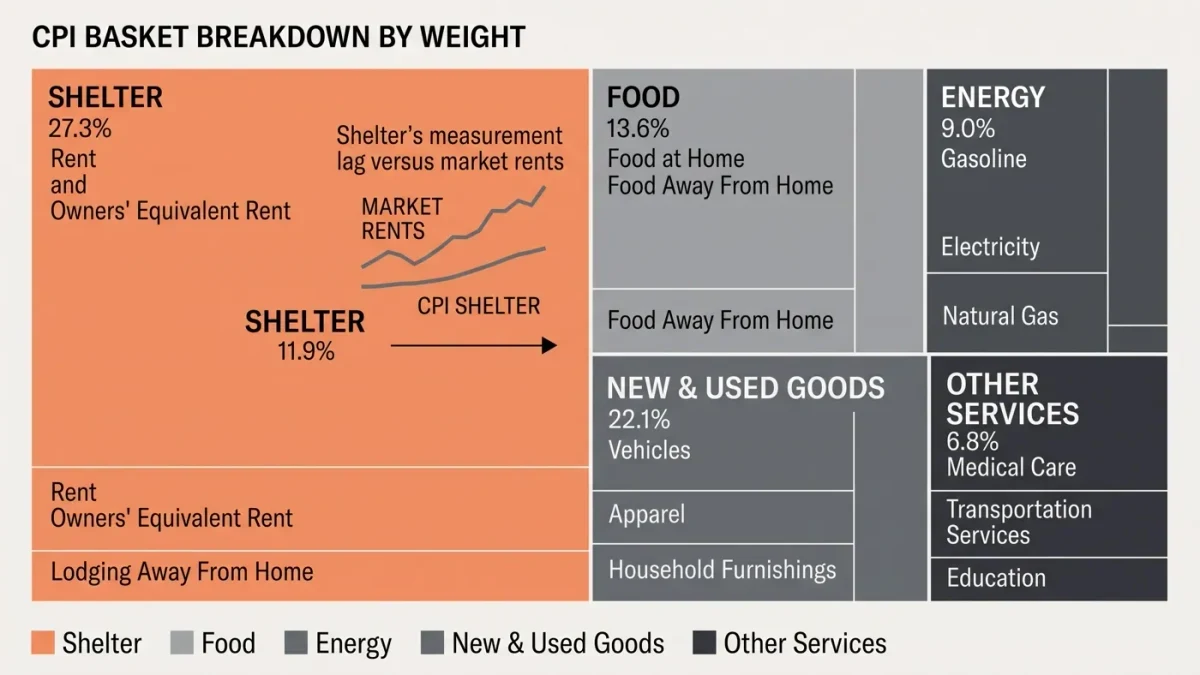
The BLS collects about 94,000 price quotes monthly in 75 urban areas for CPI, plus rent data from a survey of rental housing, and weights them using consumer expenditure surveys from roughly 24,000 diaries and interview households. The basket is fixed for a year at a time: food at about 13.5 percent of the index, shelter about 36 percent within housing's roughly 44 percent weight on services side, energy volatile throughout. Headline CPI is everything; core CPI strips food and energy, whose 2021-2023 swings of 30 to 40 percent in some categories distorted the signal the Fed watches.
How is PCE different?
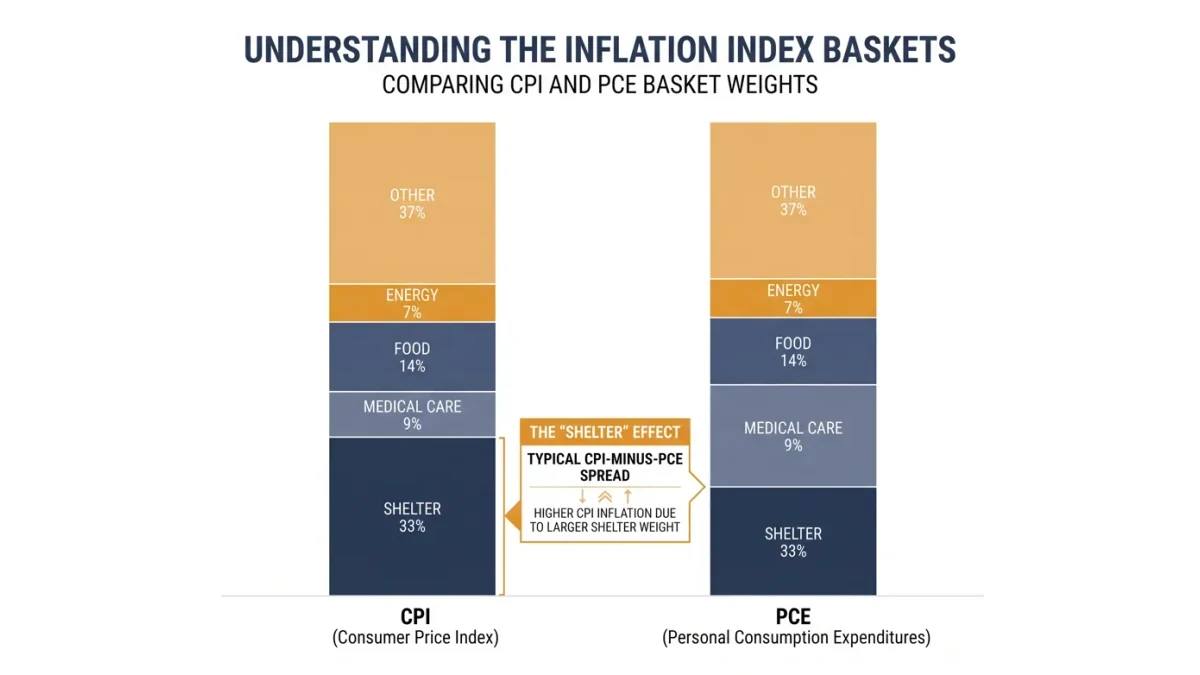
Four ways. Coverage: PCE includes spending the CPI basket misses — employer-paid health premiums, government programs like Medicaid and Medicare, and nonprofit care — which drags medical services, weighted about 17 percent in PCE versus under 9 in CPI, into the index. Weights: PCE is chain-weighted continuously, capturing substitution as consumers shift from beef to chicken when beef prices spike; CPI updates annually with a lag. Formula: the geometric means and chaining mean PCE reads smoother. Housing: shelter is about 36 percent of CPI but under 16 percent of PCE — the single largest driver of the persistent CPI-over-PCE gap. The expected arithmetic: CPI tends to run about 0.3 to 0.5 percentage points above PCE on average over long periods.
Why does the Fed prefer PCE?
History and logic. In 2000 the Federal Open Market Committee formally redefined its long-run inflation objective from core CPI to core PCE, on the recommendation of its staff: PCE's broader coverage matches the consumption it is trying to stabilize, and chain-weighting avoids the substitution bias that overstated 1970s-80s CPI by roughly a percentage point a year — the measurement error the 1996 Boskin Commission quantified. The 2 percent objective announced in 2012 is therefore a core PCE target, and every FOMC statement's inflation language refers to that measure. CPI is not retired: it sets the annual adjustment to Social Security benefits and tax brackets, the inflation-protected bonds' principal, and private wage contracts' escalators — the index the public feels directly.
What are the known distortions?
Owner-equivalent rent, the biggest. Since 1983, the CPI's shelter component measures not house prices but the imputed rent owners would pay themselves, lagging market rents by up to a year — which is why shelter inflation of about 4.5 percent in late 2024 kept headline CPI elevated even as new-tenant rents asked on leases were flat or falling per private indices. The pandemic cycle stressed everything: used-car weights were out of date as prices rose 45 percent in 2021; survey response rates fell; and the BLS added new outlets and methods to catch online shifts. Hedonic quality adjustment — subtracting the value of improved computer power, say — is technical and permanent grist for criticism that the index understates lived inflation.
Which number should a reader track?
Both, for different jobs. CPI answers what a fixed basket costs a typical urban household and moves Social Security and taxes; it is the public's number and historically the higher one. Core PCE answers what the Fed targets and moves FOMC decisions and bond markets. The analysis: the two-index system is not redundancy but a genuine disagreement about what inflation is — a fixed cost of living versus the changing flow of spending — and policy bets on the flow measure because it is less distorted by substitution and housing lags. What would change the reading is shelter methodology catching market rents faster or the Fed retargeting headline PCE, both recurring proposals that have not been adopted.
Frequently asked questions
What is the difference between CPI and PCE?
CPI, from the Bureau of Labor Statistics, prices a fixed household basket; PCE, from the Bureau of Economic Analysis, measures all consumption spending with continuously updated weights. PCE includes employer and government-paid medical care and weights housing less, so it typically runs a few tenths below CPI.
Why does the Fed use PCE instead of CPI?
Since 2000 the Fed's target — 2 percent — is defined on core PCE, chosen for broader coverage and chain-weighting that reduces substitution bias. CPI still governs Social Security adjustments, tax brackets, and TIPS.
What does core inflation exclude?
Food and energy, the most volatile components. The exclusion is a signal device — stripped of swings that monetary policy cannot smooth, core shows the underlying trend the Fed targets.
Why did shelter keep inflation high in 2024?
The CPI measures owners' housing as imputed rent with about a year's lag behind market rents. Market rents had cooled by 2024, but the index's shelter component, roughly a third of CPI, kept rising as older leases rolled over.