Recessions in the United States are dated by the National Bureau of Economic Research's Business Cycle Dating Committee, a small panel of academic macroeconomists that has held the role by convention since the 1920s and formally since the 1960s. Its definition: a significant decline in economic activity spread across the economy, lasting more than a few months, normally visible in production, employment, real income, and sales — depth, diffusion, and duration as the 2021 committee memo restated the framework. The committee's fastest call was June 8, 2020, declaring the pandemic downturn begun in February; its slowest recent call was November 2008 for a peak already eleven months past. The two-quarters-of-negative-GDP rule of thumb is not the committee's test — the 2022 episode of two negative quarters with no committee recession call settled that publicly.
What data does the committee actually read?
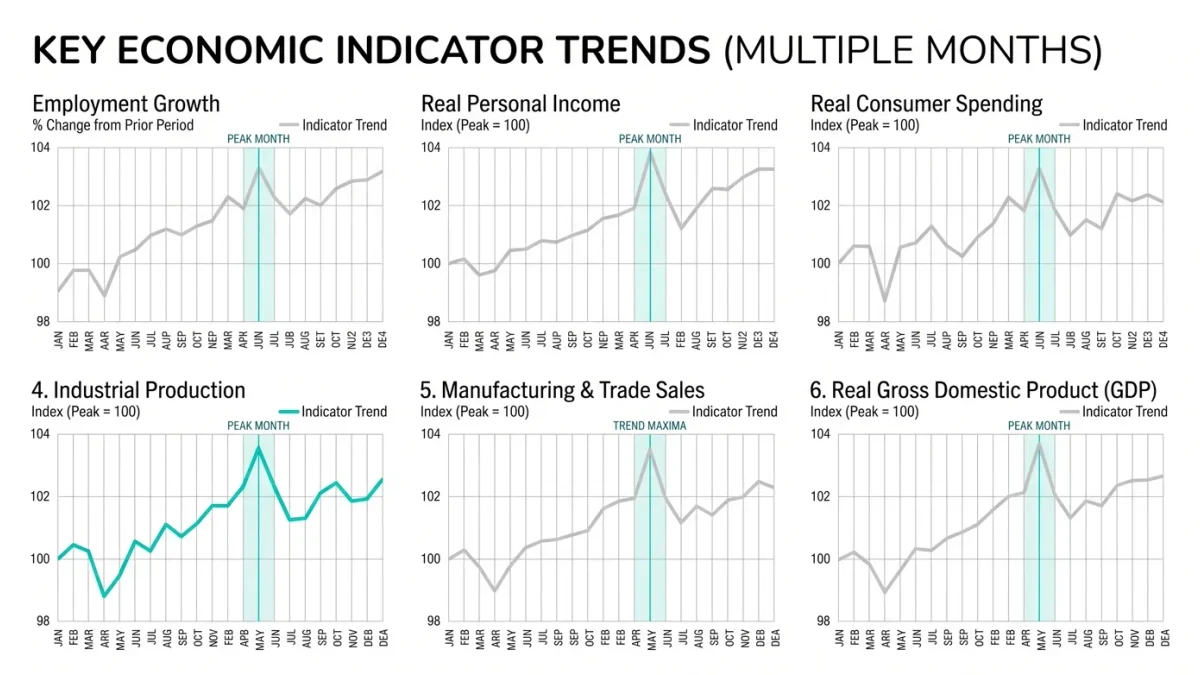
Monthly indicators first: nonfarm payroll employment and the household unemployment rate, real personal income less transfers, real personal consumption expenditures, industrial production, wholesale-retail sales adjusted for inflation, and monthly real GDP estimates the committee itself commissions. Quarterly real GDP and gross domestic income matter as cross-checks — the 2007-2009 dating leaned on employment and output together, and the 2020 downturn's extraordinary spike in income transfers was explicitly discounted as not signaling expansion. Because the indicators disagree at turning points, the committee weighs them judgmentally, which is why its product is a dated peak month, not a formula output.
Why the lag, and why the dates can be revised?
Deliberation requires data the statistical agencies have not finished revising. The committee waits until indicators have stabilized enough that a peak is unambiguous, then announces with a statement explaining the reading — the 2021 memo on the 2020 trough arrived 15 months after July 2020, and the 2001 peak call came precisely on the recession's last month because the data gave no earlier clarity. Dates have never been revised in the postwar record, a fact the committee cites as the payoff of patience: better a late, durable call than a fast, moved one, because recession dates anchor fiscal triggers, academic research, and historical comparison.
What happened with the 2022 two-quarter rule episode?
Real GDP fell at annualized rates in the first and second quarters of 2022, producing headlines declaring a technical recession under the rule of thumb used in some other countries. The committee made no call then or since: employment kept rising through 2022-2024, incomes grew, and depth-diffusion-duration was never met. The episode is now the standard illustration of the definitional gap — a GDP contraction driven by trade and inventories against a labor market adding hundreds of thousands of jobs a month is not the committee's recession, whatever the shorthand says.
Why does an unofficial committee hold this power?
Because the government never took the job. The Commerce Department tried compiling official cycle dates in the early 1960s and reverted to citing the NBER, and every administration since has lived with the awkwardness: an agency of the government's statistics depends on a private research organization for the classification of its own record. The committee's insulation is the point — no administration can lean on the dating of its own downturns — and its statements, all published on the NBER's site with the reasoning, are the whole institutional record.
What difference does the label make?
Real ones. Federal and state programs trigger on recession designations or the committee's dates — extended unemployment benefits in the pandemic response keyed to cycle dating, state rainy-day rules referencing the committee, and contracts and academic datasets anchoring on the month numbers. The label also shapes politics: the 1992 and 1992-style debate over whether the 1990-91 recession had ended turned on the committee's March 1991 trough call landing during an election year, a pattern each recession cycle repeats. The analysis: the committee exists because a recession is a judgment about the shape of an entire economy, not an arithmetic test, and the two-quarter rule survives in headlines because it is fast and falsifiable — qualities the committee deliberately trades away for durability. What would change the reading is Congress formalizing a definition, which would gain speed and lose the insulation that has kept the record unbroken since 1854.
Frequently asked questions
Who officially declares a U.S. recession?
The NBER's Business Cycle Dating Committee, by convention accepted by government statistical agencies. There is no statutory definition or official government arbiter; the committee's peak and trough calls anchor policy triggers and research.
Is two quarters of negative GDP growth a recession?
It is a rule of thumb used elsewhere, not the U.S. test. In 2022, two negative GDP quarters passed without an NBER call because employment and income kept rising. The committee weighs depth, diffusion, and duration across many indicators.
How long does the NBER take to call a recession?
From 8 to 15 months historically for peaks — June 2020 for a February peak was the fastest; November 2008 for a December 2007 peak among the slower. Trough calls take longer, 15 months or more. No postwar date has been revised.
What indicators does the committee use?
Monthly employment, unemployment, real income less transfers, real consumption, industrial production, and inflation-adjusted sales, plus quarterly GDP and gross domestic income as cross-checks. Weighing is judgmental, explained in each dated statement.